Home › Blog › What is su böreği?
What is su böreği, and how do you eat it?
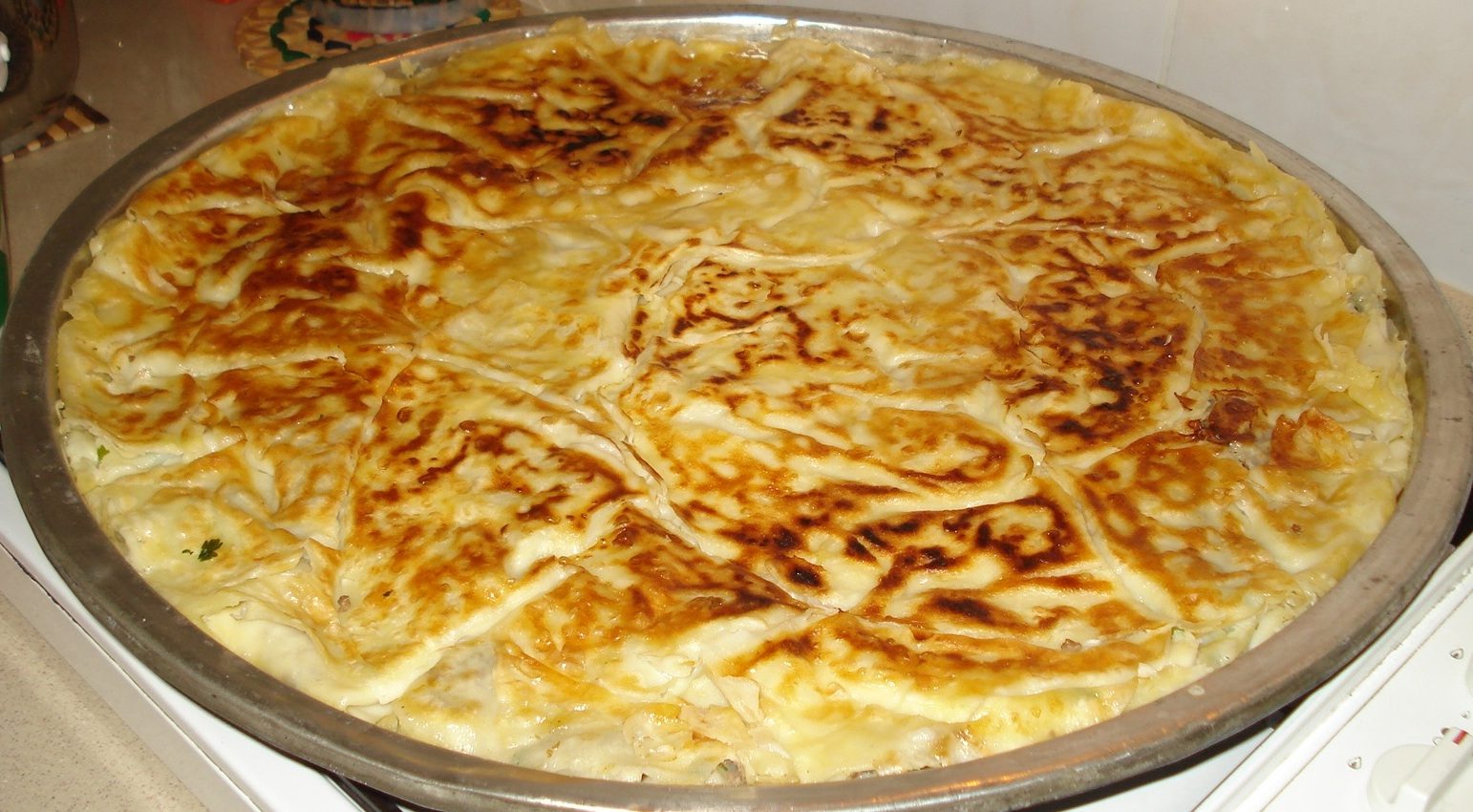
Su böreği — literally "water böreği" — is the queen of Turkish savoury pastries: a tray of paper-thin phyllo sheets briefly boiled in salted water, layered with crumbled white cheese and chopped parsley, brushed with butter and beaten egg between each sheet, and baked until the top crackles. The water bath is the defining step — almost no other börek tradition does it — and it's what gives the finished pastry its custard-soft interior beneath a crisp golden crust. A warm wedge with a glass of cold ayran is one of the great Istanbul kahvaltı orders. Here is what the dish is, why the water matters, where to eat it, and how to tell a great wedge from a mediocre one.
The short answer
Su böreği (pronounced soo bur-eh-EE) is a baked layered pastry made from very thin sheets of unleavened flour- and-water dough (yufka), assembled in a round or rectangular tray with a filling of crumbled white cheese (typically Turkish beyaz peynir) and chopped parsley between layers. Each sheet of dough is hand-rolled almost translucent on a long oklava rolling pin, briefly boiled in a wide pot of salted water for ten or twenty seconds, lifted out and laid down to drain, and then layered into the tray with a brush of melted butter and beaten egg between every sheet. The filling goes in the middle. The top is brushed with more egg-and-butter wash, and the tray bakes in a hot oven until the surface is crisp golden and the layers below have set into a soft, custard-textured pastry that holds together when cut.
The finished dish is cut into wedges or squares, eaten warm from the oven, with a glass of cold ayran — the slightly salty yoghurt drink that cuts the butter — alongside. It is one of the foundational Turkish breakfast dishes and a daily morning ritual in the Üsküdar börek-and-muhallebi street, where the canonical Istanbul börekçi rooms have been pulling trays from the oven every twenty minutes for decades.
The water bath — what makes su böreği actually su böreği
The single most important technique in su böreği is the brief boil the dough sheets get before they go into the tray. The Turkish börek tradition runs through dozens of regional variants — kol böreği rolled long, sigara böreği rolled like a cigar, çiğ börek fried raw — but su böreği is the only one where the dough is poached in water before baking. The reason is texture. The brief water bath hydrates the rolled-out yufka, partially cooks the starch, and softens the gluten just enough that the finished pastry sets soft and almost custard-like inside the crisp baked top sheet, rather than the layered shatter of a dry-baked phyllo. The difference is night and day: a dry-baked phyllo is flaky and crackles when you cut it; a water-bathed su böreği yields to the fork like a savoury bread pudding under a thin crisp lid.
The boil also seasons the dough. The water is heavily salted — properly so, to the order of a handful of coarse salt per litre — and the sheets absorb a small amount of this seasoning as they pass through. The filling never needs much salt as a result; the cheese is mild Turkish white cheese, the parsley is fresh, the binding is butter and egg, and the salt sits in the dough itself.
The boil is also why su böreği is the most labour-intensive börek to make. A professional börekçi who runs su böreği as a morning specialty has at least one cook whose entire job from before dawn is the dough: rolling each sheet of yufka thin enough to read newsprint through, boiling it, draining it, and laying it in the tray. A standard tray uses ten or twelve sheets, sometimes more. A full morning's service is fifteen or twenty trays. The hand-roll is what makes this a craft rather than a factory pastry, and a börekçi room without a visible rolling station is a room buying its yufka pre-made — which is the failure mode the last section explains how to spot.
The filling and the lamination
The standard Istanbul filling is two ingredients: crumbled beyaz peynir (the slightly salty fresh white cheese that is the Turkish workhorse cheese, similar in technique to feta but milder and less aged) and chopped flat-leaf parsley. The cheese sits in the middle of the layered stack — typically after the fifth or sixth sheet, with the remaining five or six sheets stacked above it — and the parsley is folded through. A regional variant uses minced seasoned lamb instead of cheese, layered the same way; this is the kıymalı su böreği ("minced-meat water böreği") and is the second-most-common version in Üsküdar. Other regions in Anatolia run a spinach-and-cheese version. The Istanbul canon is cheese-and-parsley.
The lamination is the second part of the technique. Between every sheet of boiled dough, the baker brushes a thin coat of melted butter mixed with beaten egg. The butter carries the fat, the egg sets in the oven into a thin custard-like glue that holds the layers together, and the visible cross-section of a cut wedge shows alternating bands of pale set custard and slightly translucent cooked dough sheets, with the cheese-and-parsley filling running through the middle. The top sheet — the one that's exposed to direct oven heat — gets a heavier brush of the same wash and bakes to a crinkled, mahogany-tinted golden crust. That top layer is the visual signature; everything beneath it is the substance.
How to eat it
Order a single wedge at the counter and a glass of cold ayran. Su böreği is sold by weight in Istanbul börekçi rooms — typically 150 to 200 grams a portion — and the standard cut is a wedge from a round tray or a square from a rectangular pan. Eat it standing at the counter or sitting at one of the small tables most börekçi rooms run; this is street food and casual indoor dining, never a sit-down restaurant order. The wedge arrives on a small plate, sometimes with a fork and sometimes not. Use your hands if there's no fork; the pastry is sturdy enough to hold its shape between fingers, and the crisp top is part of the bite.
Eat it warm — straight from the oven if possible, not held under a heat lamp. The custard-soft interior is the whole point of the dish, and it firms up and goes dense within twenty or thirty minutes of leaving the oven. A börekçi room that's running its service well will be pulling fresh trays from the oven every fifteen to twenty minutes; the wait for a fresh tray is the right wait. Ask the counter when the next tray is due if the current one's been sitting.
The drink is cold ayran. Not tea, not coffee, not fruit juice. The salt-and-yoghurt drink is what cuts the butter in the pastry and resets the palate between bites; the pairing has been the canonical Turkish börek-and-ayran order for generations. The longer story on the Istanbul kahvaltı table su böreği belongs to is in the best-Turkish-breakfast blog post.
Where to eat su böreği in Istanbul
Three canonical Istanbul börekçi rooms, ranked by institutional weight:
- Tarihi Üsküdar Börekçisi on Hakimiyet-i Milliye Caddesi, Üsküdar. The Istanbul reference. The room pulls trays from a back wood- fired oven through the morning and into the early afternoon, the cheese-and-parsley version is the daily run, the kıymalı version comes out a few times a week, and the standing counter at the front fills with the Üsküdar morning regulars by 8 am. Three minutes' walk from the Üsküdar ferry iskele and the Marmaray station. This room is also Stop 2 of the Üsküdar Asian Heritage Trail walking tour.
- Tarihi Beylerbeyi Börekçisi on Yalıboyu Caddesi, Beylerbeyi (a few kilometres north of Üsküdar centre, on the Bosphorus coast). The sister institution to the Üsküdar room. Same yufka tradition, same morning service, smaller crowd because the village is out of the central Üsküdar foot-traffic flow. Worth the bus or taxi if you're already in Üsküdar.
- Tarihi Balat Börekçisi on Kürkçü Çeşmesi Sokak, Balat. The European-side Golden-Horn counterpart in the painted-timber Balat quarter. Smaller than the Üsküdar room, the same hand-rolled technique, the same cheese-and-parsley canon. See the Balat district guide for context.
A note on the wider Istanbul scene: dozens of bakeries across the city run su böreği on the morning counter alongside other börek styles, and quality varies wildly. The three rooms above are the institutional benchmarks; everywhere else, the last-section tells help you decide whether the morning's tray is worth ordering.
What to drink with it
Cold ayran, almost always. The pairing is not negotiable in the Turkish tradition and the counter at any serious börekçi runs a steady pour of fresh ayran from a refrigerated jug into small glass tumblers. A few rooms also pour şalgam (the purple turnip-and-carrot fermented juice from the southern Turkish kebab tradition) — that's also acceptable but unusual with su böreği specifically. A glass of strong black çay works as a follow-up after the wedge is finished; some regulars order one of each — a glass of ayran to eat with the pastry, a glass of çay to sit with after. Turkish coffee arrives at the wrong scale for this kind of breakfast and is essentially never ordered alongside.
How to tell a great su böreği from a mediocre one
Three tells, in order of importance. First, the top sheet: a great su böreği has a crinkled, golden-mahogany top surface where the egg-and-butter wash has caught the direct oven heat and lifted in irregular ridges. The top should look almost sculpted. A flat, uniform-coloured top is a sign the wash was too thin or the oven too cool. A pale top is a sign the tray was pulled too early.
Second, the cross-section: cut into the wedge and look. You should see distinct layers — thin pale bands of cooked dough alternating with the slightly opaque set egg-and-butter, with the cheese-and-parsley filling running through the middle as a single visible band. Indistinct layers mean the lamination was rushed; a single thick layer of compressed pastry with no visible structure means the room used factory-rolled yufka and didn't boil it properly. Both are failures, neither version tastes right.
Third, the texture in the bite: the interior should yield like a soft savoury bread pudding under the crisp top — neither dry-and-flaky (under-boiled or over-baked) nor wet-and-soggy (over-boiled or pulled from a cold tray). A real su böreği eaten warm runs a small amount of melted butter onto the plate from the cut edge; the butter is the proof that the lamination set correctly. No butter on the plate, no butter in the bite.
What's next
Su böreği sits inside the wider Istanbul kahvaltı table — the long Turkish breakfast spread of cheeses, olives, jams, eggs, simit, çay and sometimes ayran — covered in long form in the best-Turkish-breakfast blog post. The Üsküdar Asian Heritage Trail walking tour walks the Üsküdar börek-and-muhallebi street with Tarihi Üsküdar Börekçisi as Stop 2, pairs it with the 1933 Kanaat Lokantası and the 1935 Saray muhallebici, and closes with dinner inside the Maiden's Tower at sunset. The Üsküdar district guide has the longer-form context on the whole street.
Every börekçi above is in the app.
Tarihi Üsküdar Börekçisi, Tarihi Beylerbeyi Börekçisi, Tarihi Balat Börekçisi — plus 230+ other hand-picked venues across Istanbul — mapped, addressed and walked offline in the free Taste Istanbul app. No tracking pixels, no third-party analytics. Free, no sign-in.
Download Taste Istanbul on the App Store