Home › Blog › Best Turkish breakfast in Istanbul: where to do kahvaltı properly
Best Turkish breakfast in Istanbul: where to do kahvaltı properly
The Turkish weekend breakfast is the defining Saturday-morning ritual of Istanbul — twenty small plates, three hours, endless çay, a single long table that the whole family settles in at. Where to do it properly, in the four neighbourhoods that built the tradition, plus the rules of order. Editorial picks, no paid placements.
By Sadettin Köseoğlu · 14 May 2026 · 10-minute read
What kahvaltı actually is
Kahvaltı — literally "before coffee," from the pre-1554 Ottoman habit of eating before the morning's first cup of türk kahvesi — is the Turkish word for breakfast, and the most-loaded single noun in the Turkish food vocabulary. On a weekday it is a quick affair: a glass of black tea, a piece of cheese, a slice of bread, an olive. On a Saturday or Sunday in Istanbul it is something else entirely: a sit-down, three-hour, twenty-or-thirty-small-plate communal table that the whole family settles in at around 10 am and doesn't leave until close to one, the bread basket refilling twice, the tea kettle pouring continuously, the conversation moving through politics and football and the children's school. It is the Turkish meal closest in spirit to the long Mediterranean lunch — but it is the morning version, and it is structurally communal.
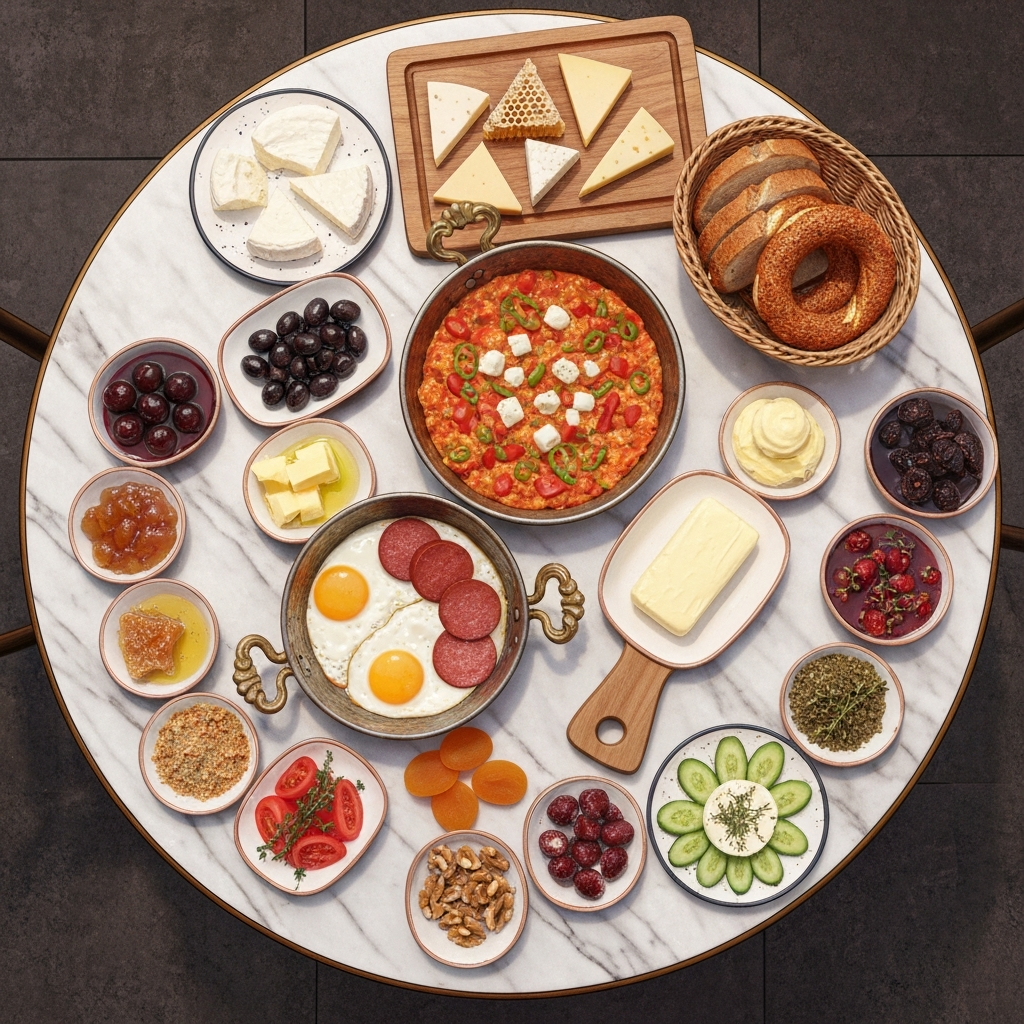
What kahvaltı isn't is a single dish. The defining feature is the spread — the kitchen sends out fifteen or twenty small painted ceramic dishes, each holding a different small thing, and you assemble your own plate from the constellation. The baseline list across every proper room is:
- Cheese. At minimum three: white beyaz peynir (the salty fresh white that is Turkey's everyday cheese), aged kaşar (the yellow firm one), and one regional speciality (otlu peynir the herb-cured cheese of Lake Van, tulum the crumbly Aegean version, or ezine the northern coast's young white).
- Olives. Black Edremit on one side, green olives marinated with thyme and chilli on the other.
- Eggs in some form. Usually menemen (the soft scramble of egg, tomato, green pepper and white cheese in a copper sahan), sometimes sucuklu yumurta (fried eggs with slices of cured beef sausage browning in the butter), occasionally a simple omelette with chopped fresh parsley.
- Bread. Warm sesame simit from the morning's first bake, with a basket of country bread and sometimes a piece of cheese börek alongside.
- The sweet half of the table. Pale-yellow kaymak (clotted cream) topped with a piece of golden honeycomb running with honey; four small dishes of jam in jewel tones — sour cherry, fig, rose-petal, quince; a small dish of butter; sliced summer fruit.
- Salads and small dishes. Thinly sliced ripe tomato and cucumber sprinkled with dried oregano; a small dish of çökelek (the dried-curd cheese) drizzled with olive oil and dotted with fresh thyme; a small dish of crushed walnuts and dried apricots; a small dish of olive oil with za'atar for dipping; a ramekin of biber salçası (red-pepper paste).
- Endless çay. Strong black Rize tea, brewed in a stacked çaydanlık kettle, served in small tulip-shaped glasses with sugar cubes on the saucer. The glass is refilled continuously throughout the meal — when it is empty you say nothing; when it is full, you have not yet finished.
There are dozens of regional kahvaltı styles in Turkey, but four of them dominate Istanbul's weekend dining: the Van-style (the fifteen-to-twenty-plate, butter-and-honey-heavy eastern-Anatolian version that put Beşiktaş's kahvaltı row on the map); the Black Sea–style (corn-bread, cornmeal muhlama, anchovy-fritter additions); the Aegean-style (lighter, olive-oil-led, with seasonal vegetables and lots of fresh herbs); and the Western-hotel-brunch format (the polished sit-down version with eggs Benedict on the side of the kaymak-and-honey table). All four are represented in Istanbul and the addresses below cover the strongest version of each.
The four neighbourhoods that built the tradition
1. Beşiktaş Çarşı — the Van-style heartland
The single densest concentration of serious Saturday- morning kahvaltı in Istanbul is the small block of the Beşiktaş Çarşı, where three Van-tradition kahvaltı rooms cluster within a hundred metres of each other.
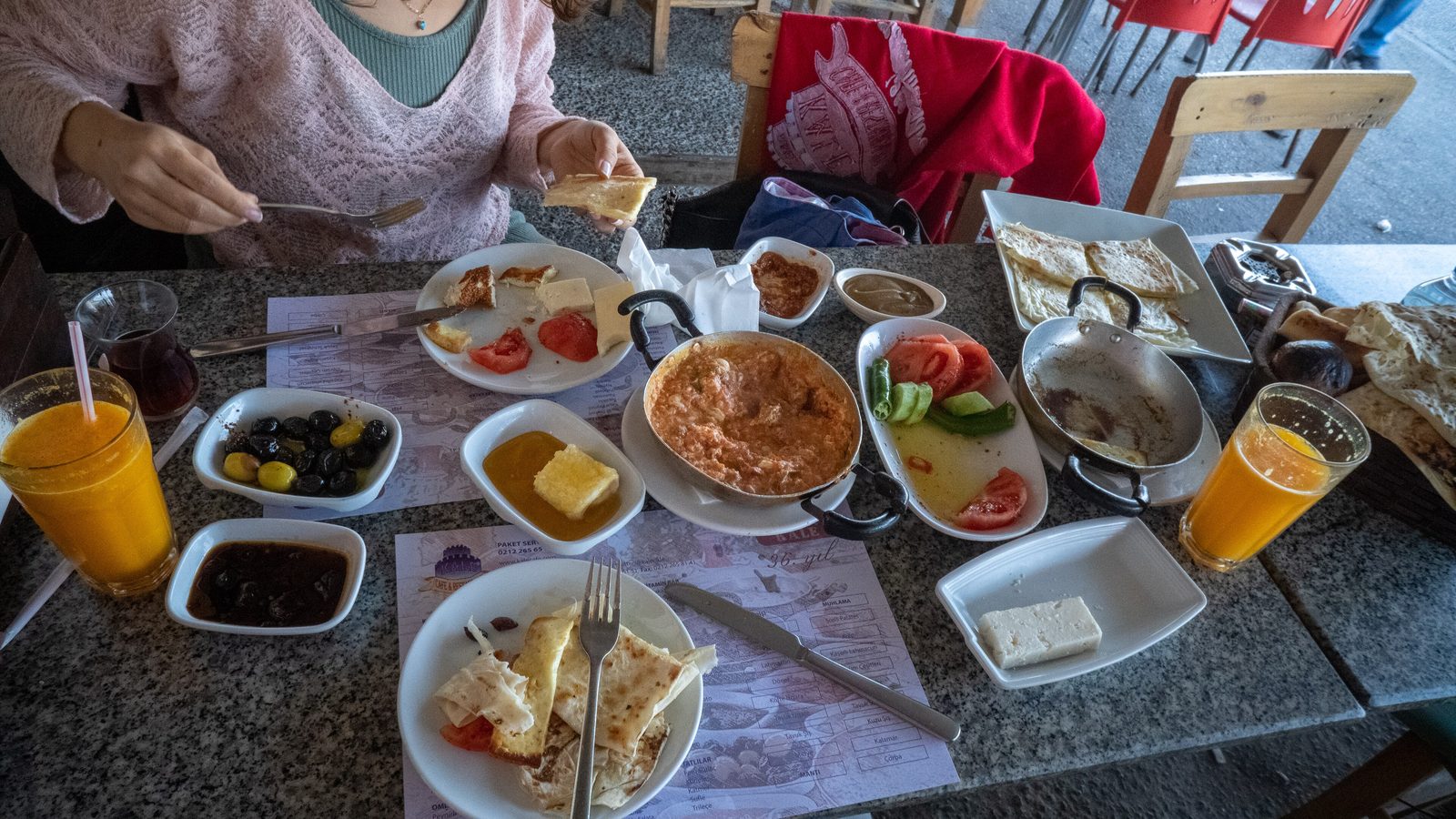
Van Kahvaltı Evi on Sinanpaşa Mahallesi is the reference — a tight room tiled wall- to-ceiling with copper trays, no booking, queues forming at 9 am on Saturday and Sunday, the fifteen- plate Van-style spread that includes otlu peynir (the herb-cured cheese of Lake Van), kavut (a roasted-grain butter spread that is one of the more obscure dishes most Turks have never tried), honey poured over fresh kaymak, walnut and pomegranate-molasses paste, three or four olives, fried eggs in a copper pan, hot menemen, simit and as much black tea as you can hold. The Van-style is the one to try first; it is the most distinctively eastern-Anatolian version of the tradition.
Çakmak Kahvaltı Salonu on Şair Veysi Sokak runs a slightly quieter version of the same idea and is the better midweek choice — the same spread, fewer queues, slightly more space at the small tables. Karadeniz Kahvaltı Evi on Beşiktaş Caddesi adds the Black Sea coast's contribution to the same block: cornmeal muhlama (the molten butter-and-cheese-and-cornmeal dish from the Trabzon hills), an anchovy fritter when hamsi are running, and a butter-rich corn-and-cheese pide served straight from the wood-fired oven. The Beşiktaş district guide has the full context on the three rooms; the Beşiktaş Morning Bites walking tour maps Çarşı kahvaltı into a five-stop morning sequence.
2. Üsküdar's börek-and-muhallebi street
On the Asian side, the long Hakimiyet-i Milliye Caddesi that runs inland from the Üsküdar iskele is the Istanbul kahvaltı tradition's pastry-led counterpart — a row of börekçi and muhallebici rooms that has fed the neighbourhood since the early 20th century.
Tarihi Üsküdar Börekçisi is the morning su böreği address — the layered white-cheese pastry baked in big copper pans, sold by weight at the counter, eaten warm with a tulip glass of strong black çay at one of the small tables along the back wall. The water-börek is the Ottoman-pastry tradition's reference dish — a paper-thin egg-and- flour pastry briefly boiled, layered in butter with fresh white cheese and parsley, then baked until the top is gold and the inside is still soft. Two pieces by weight, a glass of tea, twenty minutes; this is kahvaltı as a single warm dish rather than a sprawl. The What is su böreği? primer has the longer treatment of the dish — the water-bath technique, the lamination, and the three canonical Istanbul börekçi rooms.
For the longer version, Saray Muhallebicisi (Üsküdar) on the same street runs the full Ottoman milk-pudding-and-sit-down- breakfast service — a longer kahvaltı plate with the standard cheese-olive-jam constellation alongside a selection of milk puddings (aşure, sütlaç, keşkül) for travellers who want to read kahvaltı backwards into dessert. The Üsküdar district guide runs the full Hakimiyet-i Milliye Caddesi pastry-row story, and the Üsküdar Asian Heritage Trail walks this same street as the first leg of an Asian-shore afternoon that ends with dinner inside the Maiden's Tower.
3. Balat's Sunday-brunch wave
The painted-timber-house Golden Horn neighbourhood of Balat absorbed a wave of design-led artisan-café Sunday brunches around 2014, and the resulting rooms are the closest thing Istanbul has to the Western-style sit-down brunch tradition — a kahvaltı spread alongside menemen, eggs Benedict variants, and a long flat-white-and-pour-over coffee programme.
Forno Balat on Fener Kireçhane Sokak runs a wood-fired-oven brunch programme out of a 19th-century timber building with the painted Balat houses visible from every table. The kahvaltı plate is the long Western-leaning one (the menemen here is one of the better in the city, with the brunoise of green pepper folded in at the end so the colours stay sharp); the wood-fired pizza menu starts at noon. Balat Kahvesi on Vodina Caddesi runs the design-led modern counterpart with the best-curated retail wall in the neighbourhood — the small jars of Anatolian honey, the olive-oil-and- thyme-soaked white cheese, the pomegranate molasses, all of which you can buy on your way out. See the Balat district guide for the full restored-Ottoman café row including Cumbalı Kahve in Ayvansaray and Kocakarı Kahvesi on Hisaraltı, and the Balat & Fener Walk for the morning-to-sunset walking version — Balat Kahvesi is Stop 2 — that ends with a Rum-accented meyhane by the Greek Orthodox Patriarchate in Fener.
4. Bebek's Western-hotel brunch — the polished version
The northern Bosphorus village of Bebek runs the most polished sit-down brunch in the city, in two rooms that have spent decades figuring out how to do the Western-hotel-brunch format without losing the underlying Turkishness. Mangerie Bebek two floors up on Cevdet Paşa Caddesi is the long-running reference — a sit-down kahvaltı spread with the standard cheese-olive-jam constellation, a serious menemen and eggs Benedict list, a long bread basket including warm açma (the soft enriched-dough bread that is the Turkish answer to brioche), and the Bosphorus view from the rooftop terrace. The Beşiktaş district guide covers the full Bebek café row including Bebek Kahvesi (the Turkish-coffee institution), Lucca Bebek (the design-led modern counterpart), and Mado Bebek (the Maraş-ice-cream chain's local outpost).
For the historic-peninsula counterpart with a sultanahmet-at-dawn flavour, the Sultanahmet at Dawn walking tour starts with a börek-and-simit kahvaltı at Hafız Mustafa (Sirkeci) before the cruise-ship crowds arrive — a sit-down Western brunch this isn't, but a proper Ottoman-tradition kahvaltı with the Hagia Sophia visible across the square absolutely is.
How to order at a proper Saturday kahvaltı
The order ritual at a Van-style kahvaltı room is structurally different from the point-at-the-menu-and-wait pattern most travellers are used to. The room usually has two or three set kahvaltı options on the menu, distinguished by portion size: "serpme kahvaltı" (the sprawl — fifteen or twenty plates, the full spread for two people, what you order if you have the time and the appetite), "karışık kahvaltı" (the mixed plate — a smaller version with eight or ten dishes on a single platter, for one person who wants to taste the range), and individual à la carte items (menemen, sucuklu yumurta, a single piece of börek) for travellers who only want a quick stop.
The right order for two people on a Saturday morning is the serpme for two, plus one extra menemen if anyone at the table is from the Van tradition (the menemen is the only egg dish that arrives sized for the table rather than the individual), plus a small bowl of clotted kaymak with honeycomb on the side. The bread arrives in two waves — a basket of simit and country bread first, a second basket of warm açma ten minutes later when the spread is on the table.
Three things to know about the tea:
- Çay arrives in a tulip-shaped glass on a small saucer with two sugar cubes. The sugar is traditional but most modern Istanbullular skip it.
- The tea kettle (çaydanlık) is a stacked two-tier brass-or-steel set: the bottom pot holds boiling water, the top pot holds strong brewed tea concentrate. The waiter pours a small amount of concentrate into your glass, then dilutes it with boiling water to your strength preference. Hand gestures: a low hand-wave means "light" (açık); a higher one means "strong" (demli).
- The glass is refilled continuously. To stop refills, place the spoon across the top of the empty glass. There is no upper limit on how many glasses of tea you can drink at kahvaltı — five to eight is normal.
When to walk past
Walk past anything calling itself "Turkish breakfast" in a Sultanahmet hotel lobby that consists of a small plate of plastic-wrapped white cheese, three olives, a slice of cucumber, a hard-boiled egg, and a packet of supermarket jam alongside a single croissant. That is not kahvaltı. That is a tourist-trade approximation that exists because it can be pre-prepared at 6 am and held under a lamp until the bus pulls up.
The actual ritual requires the morning's first-baked simit, fresh kaymak from a small producer (kaymak loses its texture inside twelve hours), the day's first pour of menemen, and the fifteen-minute walk to a room that does it seriously. Hotel breakfasts can be excellent — a proper sit-down hotel kahvaltı at a Çırağan Palace Kempinski or a Pera Palace runs to the same fifteen- plate format and is a perfectly correct way to do the meal — but most tourist-trade breakfasts in the old city are a different thing, and the difference is roughly the same as the gap between a real Italian breakfast cornetto and a stale pastry under plastic wrap.
How to pair kahvaltı into a trip
A working sequence for a kahvaltı-heavy Istanbul weekend:
- Saturday morning, 9 am — Beşiktaş. Queue at Van Kahvaltı Evi in Sinanpaşa. The fifteen-plate Van-style spread, 90 minutes minimum, do not over-order pastries afterwards. This is the full serpme sprawl.
- Saturday afternoon — the Beşiktaş–Bebek coast walk. The 6 km coastal walk from Beşiktaş up to Bebek is the ideal post-kahvaltı movement. Coffee at Bebek Kahvesi when you arrive.
- Sunday morning, 10 am — Balat. Walk the painted-house slope and brunch at Forno Balat or Balat Kahvesi — the Western-style brunch counterpart with the wood-fired-pizza-by-noon option.
- Sunday afternoon — Üsküdar. Take the ferry across to Üsküdar; a slice of su böreği at Tarihi Üsküdar Börekçisi with a glass of çay, followed by the Hakimiyet-i Milliye Caddesi muhallebi-row walk to Saray Muhallebicisi for Ottoman milk puddings.
Two kahvaltı meals across a weekend, two afternoon-pastry stops, two coffee stops — and you have eaten the four versions of the Istanbul breakfast tradition in the four neighbourhoods that do them best. The walking-tours meta-guide sorts the rest of the 16-tour catalogue alongside.
The short version
Van-style kahvaltı in the Beşiktaş Çarşı — Van Kahvaltı Evi, Çakmak Kahvaltı Salonu, Karadeniz Kahvaltı Evi. The Ottoman-pastry counterpart in Üsküdar — Tarihi Üsküdar Börekçisi and Saray Muhallebicisi (Üsküdar). The Western-style sit-down brunch wave in Balat — Forno Balat and Balat Kahvesi. The polished Bosphorus- view version up the coast in Bebek — Mangerie Bebek. Order the serpme. Drink eight glasses of tea. Don't stop until 1 pm.
The full kahvaltı list is in the app.
Every venue named here, plus 230+ more across Istanbul — mapped, addressed, and walked offline. Free, no sign-in, no tracking.
Download free on the App Store