Where to eat in Balat
A walking food guide to Istanbul's painted-timber Golden Horn neighbourhood — historically home to the city's Sephardic Jewish, Greek-Orthodox and Armenian communities, and food-wise the surviving capital of the multicultural Istanbul meyhane tradition. A pastry street that has fed three faiths on the same block for a century. A wave of artisan cafés in restored Ottoman houses that landed about ten years ago and built one of the city's most distinctive Sunday-brunch scenes. And a chain of fish lokantas along the Golden Horn waterfront that locals defend the way Parisians defend their bistros. Hand-picked. No user reviews. No paid placements.
What Balat is, and isn't
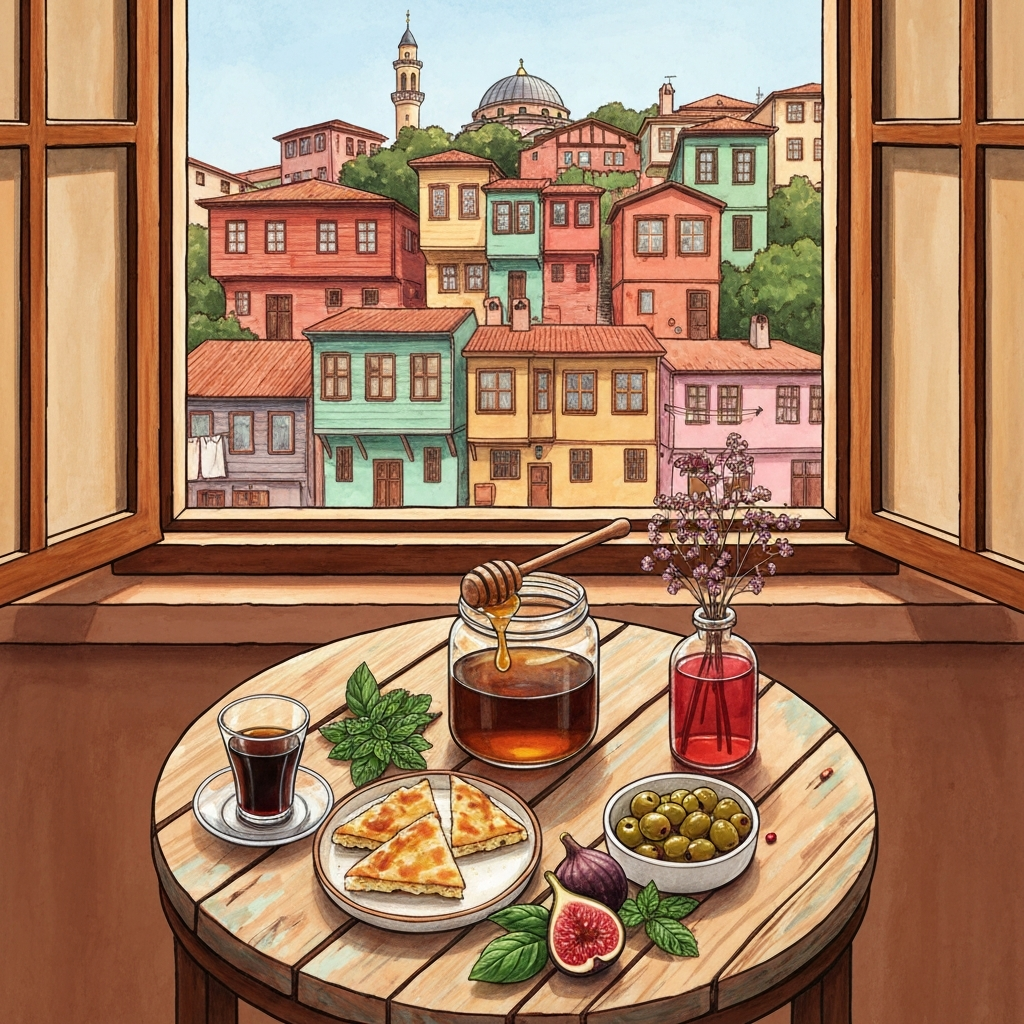
Balat sits on the European shore of the Golden Horn, halfway between the historic peninsula and the Theodosian Land Walls — close enough to Eminönü that the Süleymaniye dome is visible across the water, far enough up the Horn that the cruise-ship grid has not arrived. It is the steeply-sloping neighbourhood of painted nineteenth-century timber houses (the multicoloured façades the neighbourhood is now best known for came partly out of a 2003 restoration programme and partly out of older Sephardic-Jewish and Greek-Orthodox painting traditions), the seat of the Ecumenical Patriarchate of Constantinople at the top of the slope in the Phanar (Fener) district that abuts Balat, and historically the home of three of Istanbul's most consequential minority communities. Walk up any side street and you cross a synagogue, a Greek-Orthodox church, an Armenian church and a mosque inside a single quarter-kilometre.
What Balat isn't is a polished restaurant district. The food culture here is one of small rooms, family kitchens, painted shopfronts and a couple of long-running meyhanes that the neighbourhood would close ranks around if anyone threatened them. The artisan-café wave that arrived around 2014 — the design-led Sunday-brunch rooms in restored Ottoman buildings — has changed the weekend rhythm but not the underlying texture. On a Tuesday morning the painted houses are still mostly quiet, the bakery street still runs on local custom, and the meyhanes still wait for evening.
This guide names them. Every venue below has been chosen for one of four reasons: a generational connection to Balat's multicultural food culture, a setting in a restored historic building that is itself a reason to visit, technical excellence in a single dish, or a role in the Golden-Horn-waterfront tradition that runs from Balat through Fener to Cibali and Ayvansaray. There are no paid placements.
🗺️ Want this as a walking tour?
The free Taste Istanbul app maps the Balat & Fener Walk — five stops, three hours, 2.5 km, the only tour in the catalogue flagged Moderate (the Balat slope is steep). A stone-oven bakery, coffee in a restored Ottoman house, a pastane keeping Balat's Sephardic bakes alive, the historic Agora meyhane, and a closing Rum-accented meyhane by the Greek Orthodox Patriarchate in Fener. Offline mode and one-tap directions to every venue below.
Download Taste Istanbul on the App Store
The five things to eat in Balat
1. The historic meyhanes
Balat's signature dining room is the historic meyhane — the multi-generation neighbourhood drinking-and-eating house that runs on cold mezes, rakı, grilled fish, and a long evening. Agora Meyhanesi on Hisaraltı Caddesi is the reference: a Sephardic-Jewish founding family, a small low-ceilinged dining room behind an unprepossessing painted door, walls hung with framed black-and-white photographs of the neighbourhood across a century, and a cold-meze table that runs to twenty plates — taramasalata, lakerda (cured bonito), octopus salad, fava bean purée, fried artichoke hearts, the Sephardic roscas sesame-seed rolls, hand-cured marinated bonito (çiroz) — followed by whichever fish came in that morning. Fener Meyhanesi on Fener Rıhtımı is the Greek-Orthodox counterpart on the Fener waterfront, run by a family with one foot still in the Patriarchate's lay community. Karabaş Meyhanesi on Vodina Caddesi is the quieter neighbourhood version — six tables, a chalkboard menu, no English. Cibalikapı Balıkçısı on Kadir Has Caddesi in Cibali (the small district immediately south of Balat) is the larger Golden-Horn-fish-meyhane room with a long marble cold-meze counter and a wine list that is better than the room's modesty suggests.
2. The bakery street
Balat's pastry tradition was historically Sephardic, Armenian and Turkish all on the same lane. The surviving institutions are clustered along Vodina Caddesi and the few cross streets above it. Tarihi Balat Börekçisi on Kürkçü Çeşmesi Sokak is the morning börek address — the layered su böreği baked in big copper pans, sold by weight, eaten warm with a glass of strong black tea. Şimdi Pastanesi on Balat Çarşısı is the multi-generation patisserie, named for the Sephardic word for the spices used in its biscuits and now a Turkish-owned third-generation room running the same recipes; the kurabiye tray (the almond-and-mahleb biscuits) is what you take home. Tarihi Görkem Pastanesi at Vodina Caddesi No. 123 runs the Armenian-tradition milk puddings — the kazandibi and a long sour-cherry-and-pistachio profiterol are the dishes — and Balat Fırını on the corner of the Balat Mahallesi square is the everyday baking oven the neighbourhood actually buys its bread from. The four addresses are four minutes apart, all within the same painted-house bowl, and an hour spent walking between them is one of the better small rituals in the old city.
3. The restored-Ottoman artisan-café wave
The wave of design-led artisan cafés in restored Ottoman buildings that landed in Balat around 2014 is one of the cleaner examples of an old Istanbul neighbourhood absorbing a new generation without being displaced by it. The rooms are small, photographed often, and on a Sunday morning the queues stretch onto the painted side streets. Forno Balat on Fener Kireçhane Sokak runs a wood-fired-pizza brunch programme out of a 19th-century timber building with the painted Balat houses visible from every table. Balat Kahvesi on Vodina Caddesi is the design-led modern coffee room with a long Sunday brunch and the best-curated retail wall in Balat — the small Anatolian honey, the olive-oil-and-thyme-soaked white cheese, the pomegranate molasses. Cumbalı Kahve on Kürkçü Çeşmesi Sokak in Ayvansaray (Balat's next-door village, two minutes' walk west) is the quieter neighbourhood version, named for the cumba (the overhanging timber bay window) of the 19th-century house it occupies. Kocakarı Kahvesi on Hisaraltı Caddesi runs the most local-feeling of the four — a small painted room, mismatched cups, the day's pastry on a single ceramic plate. And Ottoman Café on Balat Sokak is the historicist counterpart, in a longer-running space than the others, with a chairs-and-tea setup that lands closer to a heritage coffee-house than to the brunch wave.
4. The street-food triad and the köfteci
Balat's street-food tradition runs to three things in particular — kokoreç, lahmacun, and köfte — and the addresses for each are short and specific. Tarihi Balat Köftecisi on Leblebiciler Sokak is the long-running köfte room — hand-shaped grilled meatballs, white-bean piyaz, pickled chillies, charred peppers, bread that arrives hot — the Balat counterpart to the Sultanahmet and Beşiktaş köfte institutions. Köfteci Arnavut on Mürselpaşa Caddesi runs the Albanian-Balkan version of the same dish (slightly larger, slightly more peppered, served with a bowl of warm white-bean stew) and doubles as the morning börekçi for the waterfront end of the neighbourhood. Ayvansaray Lahmacun on Ayvansaray Caddesi is the wood-fired-lahmacun specialist — the paper-thin flatbread with minced lamb, parsley, sumac, lemon, eaten rolled up like a cigar — sold from a single small painted-tile shopfront at the western end of the neighbourhood. Cibali Kokoreç on Kadir Has Caddesi in Cibali two minutes south runs the late-night kokoreç (grilled seasoned lamb intestines on a horizontal skewer, sliced into bread with tomato, onion and dried chilli flakes) — eaten standing, after midnight, with a small glass of pickled- juice from the cart next door. Together they define the lunch-and-late-night spectrum the neighbourhood actually feeds itself with.
5. The Golden-Horn fish lokantas
The Golden Horn — the deep narrow inlet between Balat and the historic peninsula across the water — has had a fishing-community waterfront for two millennia, and the surviving fish-lokanta tradition runs along the Balat–Fener–Ayvansaray shore. Vodina Balıkçısı on Vodina Caddesi is the neighbourhood reference — a small painted- front fish room with the day's catch on crushed ice in the window, a short fixed-price menu, and a rakı list that's modest but correctly chosen. Balat Sahil Restoran on Mürselpaşa Caddesi runs the larger waterfront counterpart with the Golden Horn directly in front of the dining room and the Süleymaniye Mosque on the historic peninsula across the water — the setting is the proposition. Fener Sahil Balık on Fener Kireçhane Sokak is the quieter Fener-shore version. Halıç Yat Klübü Restaurant on Abdülezel Paşa Caddesi runs the upscale formal-fish dinner if you want the Galata-Bridge-tablecloth proposition in a Golden-Horn setting; the dining room sits directly on the Halıç (Golden Horn) yacht-club pontoon. Ayvansaray Balıkçısı on Ayvansaray Kuyusu Sokak is the further-west neighbourhood counterpart — a small painted room, the day's catch grilled to order, the bill half what the equivalent meal would cost on the Bosphorus shore.
How to plan a day around food in Balat
Balat runs across a long afternoon into evening — morning is for the painted-house photographs and the bakeries; afternoon for the artisan cafés; the waterfront meyhanes peak around 8 pm. A working sequence, drawn from the Balat & Fener Walk in the app:
- 10 am. Warm su böreği at Tarihi Balat Börekçisi on Kürkçü Çeşmesi Sokak with a glass of black çay. Ten minutes, twenty lira.
- 11 am. Walk up the painted slope — the cobbled side streets between Vodina and Hisaraltı — to the Phanar Greek Orthodox Patriarchate at the top. The bell-tower and the painted houses lining the climb are the most-photographed stretch in the neighbourhood; allow forty-five minutes without rushing.
- 12:30 pm. Lunch at Tarihi Balat Köftecisi on Leblebiciler Sokak. The plate, the piyaz, the cacık, the ayran.
- 2:30 pm. Coffee at Balat Kahvesi or Forno Balat. Sunday brunches are the room's defining service; weekday afternoons are quieter and arguably better. Pick up a small jar of honey or pomegranate molasses on the retail wall on the way out.
- 4:30 pm. Walk down to the Golden Horn waterfront. Tea at one of the small cafés along Mürselpaşa Caddesi; the Süleymaniye dome sits directly across the water as the light turns gold.
- 8 pm. Dinner at Agora Meyhanesi on Hisaraltı Caddesi — the long cold-meze evening with rakı and grilled fish. Or Cibalikapı Balıkçısı two minutes south for the bigger meze-and-fish proposition. Each is a different read on the Balat evening and both are correct.
The full route is mapped in the Taste Istanbul app with walking directions, distances, and per-stop notes — free, offline, no sign-in.
Other districts to combine with Balat
Balat is the upper-Golden-Horn anchor. A well-planned three-day food trip pairs it with:
- Eminönü — fifteen minutes downhill along the Golden Horn coast or three stops on the ferry, the commercial waterfront of the historic peninsula. The 1664 Spice Bazaar, the balık-ekmek boats at the iskele, the 1871 coffee roaster, and Pandeli (1901) above the bazaar gate.
- Sultanahmet — the historic peninsula's monumental quarter. Ottoman dawn breakfasts, the 1920 köfte institution on Divanyolu, and the Hagia-Sophia–Blue-Mosque axis.
- Karaköy — across the Galata Bridge, the port-side modern dining neighbourhood. The 1949 baklava reference, modern Anatolian fine dining at Neolokal, and the third-wave coffee culture that arrived in Istanbul on these streets first.
- Beyoğlu — the modern half of central Istanbul, uphill from Karaköy. Late-night kokoreç, profiterol since 1944, and the meyhane culture of Nevizade Sokak.
The full guide is in the app.
Every venue named here, plus 15+ more across Balat and the surrounding Golden Horn villages — and 230+ across the rest of the city — is mapped, addressed, and walked in the free Taste Istanbul app.
Download free on the App Store