What is künefe?
Künefe is a hot Turkish dessert from the southern Antakya / Hatay border region — shredded kadayıf pastry layered over fresh stretchy white cheese, baked over high direct heat in a small round copper pan until the kadayıf turns dark amber and the cheese underneath melts to a stretchy molten interior, then drowned in a light sugar syrup and crowned with a heavy dusting of crushed Antep pistachios. It is served immediately, boiling hot, sometimes with a single scoop of Maraş dondurma melting alongside. Künefe is the one Turkish dessert that's eaten hot, the only one structurally built around stretchy white cheese, and the dish whose timing — kitchen to table in under three minutes — is half the point. Here is what it is, why the cheese stretches, the Antakya origin, and the four Istanbul rooms that get it right.
The short answer
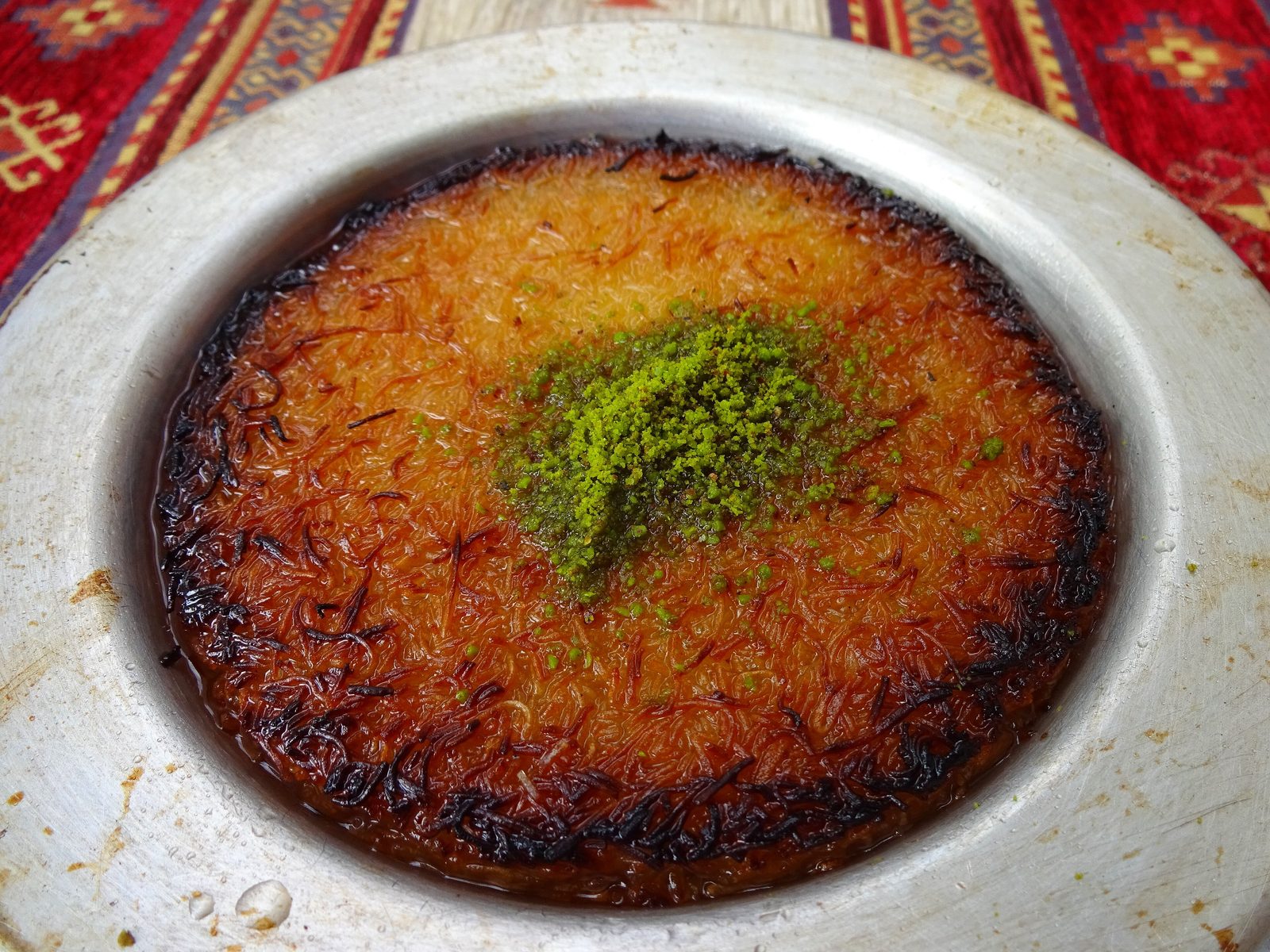
Künefe (pronounced KOO-neh-feh) is a hot baked dessert of two parts: the kadayıf, a long fine strand of dough that looks like extruded angel-hair pasta, and a layer of fresh stretchy white cheese. The kadayıf is made by drizzling thin flour-and-water batter onto a hot copper plate through a many-holed dispenser, where it sets in seconds into pale yellow noodle-like strands that the cook lifts off in long ribbons. For künefe, the fresh kadayıf is chopped to one-inch lengths and tossed with melted clarified butter (tereyağı) until each strand is glossy. A layer of the buttered kadayıf is pressed into a small round copper pan; a layer of fresh high-fat unsalted Hatay white cheese (peynir) goes on top; another layer of kadayıf seals the cheese; the pan goes onto direct high heat — open flame at the better rooms, a griddle plate at others — and the cook turns and presses the pan continuously for two or three minutes until both faces of the kadayıf are baked dark amber and the cheese has melted to a stretchy molten interior. The cooked pan is flipped onto a serving plate (or simply slid out of the copper), and a ladle of warm light sugar syrup (şerbet) is poured over the top until the pastry is fully soaked through. Crushed Antep pistachios go on as the final garnish. The whole thing arrives at the table within sixty seconds of leaving the heat.
The bite is unlike anything else in the Turkish dessert catalogue: the kadayıf is crisp-edged and syrup-soaked, the molten cheese pulls into long elastic strands behind your fork, the pistachio crunch is fresh on the tongue, and the whole dish is hot enough to burn the roof of your mouth if you're not careful. A first-timer should let it sit for thirty seconds, then break a small section with a fork and lift it slowly — the cheese will stretch half a metre between fork and plate before it breaks.
Why it's served hot — the cheese is the reason
The single defining feature of künefe is that it's the only Turkish dessert eaten hot from the oven, and the reason is the cheese. The künefe cheese is fresh unsalted white cheese from the Hatay border region, high in fat content, low in moisture, and specifically chosen for its stretching behaviour at temperature. When the cheese hits high heat, the casein proteins soften and the fat melts; the resulting molten structure is elastic — pulled apart, it stretches into long thin strands before it breaks, the way mozzarella does on a hot pizza. Below about 50°C that elasticity is gone: the cheese sets back into a stiff curd that's neither chewable in the same way nor as flavourful. A künefe that's been sitting on a counter for ten minutes is a different dish from a künefe that just left the oven.
This is why every serious künefe room operates by the same rule: the kitchen makes the dish to order, one pan at a time, and the waiter carries it to the table the moment it lands on the serving plate. The diner eats it immediately, ideally inside ninety seconds of the pan coming off the heat. A room that pre-bakes künefe and holds it for service is not a room serving real künefe.
The cheese also explains the dish's geography. Fresh Hatay white cheese with the stretching behaviour künefe needs travels poorly, especially before modern cold chains; the dish was historically confined to the southern Anatolian and northern Syrian border region — Antakya, Hatay, Gaziantep, plus parts of what is now Lebanon and Syria, where the dish exists as knafeh in Arabic. It moved north to Istanbul as a restaurant dish only in the 20th century, mostly through the Antakya diaspora and the southern Turkish hotel-and- restaurant migration.
The kadayıf, the syrup, the pistachio
The kadayıf is the second technical anchor. Real kadayıf is made the morning of service — never bought pre-dried — by a specialist using a perforated batter dispenser over a flat copper plate heated by an open flame. The cook moves the dispenser in slow circles, pulling long fine strands of pale yellow pastry off the hot plate in continuous ribbons, then piling them in a basket to cool. A serious künefe room either makes its own fresh kadayıf in a back kitchen or buys it daily from a local kadayıfçı. A room buying industrial dried kadayıf from a supermarket is skipping the most labor-intensive component; rehydrated industrial kadayıf doesn't crisp the same way over high heat.
The syrup is the third. A real künefe syrup is one part sugar to one part water, brought to a brief boil with a small squeeze of lemon to prevent crystallisation, and held just below boiling at the pour. The pour is generous — a full ladle over a single pan — and the syrup runs through the kadayıf and pools at the bottom of the plate. Too little syrup produces a dry, crunchy künefe that isn't right; too much produces a sloppy overflow that drowns the cheese-stretch. The cook's calibration of the pour is where individual rooms develop their signatures.
The pistachio is the fourth. Real Antep pistachios (from Gaziantep, the same nut used in good baklava) crushed coarse, mounded heavy on top of the syrup- soaked pastry, and ideally added in the last seconds before the pan leaves the kitchen. The pistachio is the only contrasting texture in the dish — crunchy against the soft pastry, fresh against the cooked syrup — and skimping on it fundamentally damages the architecture of the bite.
The Antakya origin
Künefe is the signature dessert of Antakya, the modern Hatay province on the southern Turkish border with Syria. Antakya is ancient — it was Antioch, one of the four great cities of the classical Mediterranean — and its culinary tradition sits inside the wider Levantine pastry family that runs through Lebanon and Syria. The Arabic-speaking parts of the same region have the same dish under the name knafeh; the Palestinian Nablus tradition makes a version with semolina-tinted-orange pastry rather than kadayıf strands; the Lebanese run a version with a denser cheese; but the Antakya-Hatay Turkish version with kadayıf and stretchy white cheese is the one that reached Istanbul.
The diaspora-restaurant tradition in Istanbul started in the late twentieth century. Antakya- family restaurants in Karaköy and Beyoğlu introduced the dish to a northern audience that had never seen a hot Turkish dessert with stretching cheese, and the Gaziantep grilling dynasty Develi added künefe as the closing course of their kebab tasting menus from the early 2000s onward. A few decades later, künefe is on every dessert menu in the city — but the rooms that do it right are still the ones with a direct Antakya or southern-Turkish line.
Where to eat künefe in Istanbul
Four canonical rooms:
- Antiochia Meze Bar — Necatibey Caddesi No. 22, Karaköy. The Antakya-tradition Karaköy room — the name itself is the Greek-and-classical form of Antakya. The kitchen runs the southern Hatay programme end-to-end (cold and hot Antakya mezes for the savoury half, the canonical künefe for the closing course). This is the most editorially explicit Antakya restaurant in central Istanbul, and the künefe pour and pistachio mound here are reference. Antiochia is also Stop 4 of the Karaköy Meze Trail walking tour.
- Develi Etiler — Nispetiye Caddesi No. 71, Etiler. The Gaziantep grilling dynasty's fine-dining flagship, and the closing course of the Istanbul Kebab Trail walking tour. The künefe here is the polished version — the kadayıf is crisped to a perfect amber, the syrup pour is calibrated to the gram, and the pistachio is fresh-crushed Antep from the family's southern supply chain. The most refined künefe in the city, in the most formal setting; book ahead.
- Hafız Mustafa 1864 — multiple branches in Sultanahmet (Hocapaşa Hüdavendigâr Caddesi No. 4, Divanyolu Caddesi No. 14). The Ottoman-pastry dynasty's künefe is a Sultanahmet-tourist-friendly version — served in the same small copper pan, made to order in the back oven, available throughout the day. Less specifically Antakya in its register than Antiochia or Develi, but technically correct and conveniently located for visitors walking the old city. This is Stop 1 of the Sultanahmet Sweet Tooth walking tour.
- Develi Sirkeci / Develi Sultanahmet — the dynasty's working-room branches in the historic peninsula. Same kitchen tradition as Develi Etiler at a more casual register and a lower bill; the künefe is on the same menu and worth ordering at the end of a kebab meal.
How to eat it
Order one pan per person — never one to share, the dish doesn't survive the seconds you'd spend splitting it. The pan arrives directly from the kitchen, often still hissing audibly from the syrup-on-hot-copper sound. Let it sit for thirty seconds — both to cool the surface enough to eat, and to let the syrup penetrate the kadayıf completely. Then break a small wedge with a fork — not a knife — and lift slowly. The cheese will stretch behind the fork in long elastic strands; move the fork toward your mouth in a slow arc so the strands don't break against the plate edge. Eat the wedge in one or two bites; the heat is the half the dish.
Continue this way — slow wedge, fork lifted high, cheese stretch, bite — until the pan is empty. Eight or ten bites is typical. A scoop of Maraş dondurma (the stretchy mastic-gum-bound Turkish ice cream from Kahramanmaraş) on the side is the canonical accompaniment; the cold-and-hot contrast and the two-stretchy-textures pairing is the southern Turkish ice-cream-and-künefe order.
What to drink with it
Türk kahvesi orta (medium-sweet Turkish coffee) is the canonical pairing — the bitter coffee against the sweet pastry, the small porcelain demitasse beside the copper pan, the after-dinner Ottoman closer that the meal arcs toward. A glass of strong black çay works as the lighter version of the same pairing. Western coffee (espresso, filter, pour-over) is technically fine but doesn't fit the cultural register; cold drinks damp the heat of the dish and shouldn't be ordered. The longer story on Turkish coffee is in the best-Turkish-coffee blog post.
How to tell great künefe from mediocre
Three tells, in order. First, the timing: a great künefe arrives at your table within ninety seconds of leaving the heat. A pan that's been sitting on the pass for five minutes has lost the cheese stretch and is no longer the dish. If you can hear the syrup hissing on the hot pan when the waiter sets it down, you're in the right room. If the pan is room-temperature in your hand, you're not.
Second, the cheese stretch: pull a fork up from a corner. The cheese should pull into long elastic strands at least a hand's width before it breaks. A cheese that just lifts straight up without stretching means it's either the wrong cheese (cottage cheese, ricotta, an industrial substitute) or it's already cooled past the elastic stage.
Third, the kadayıf colour: dark mahogany amber, with the visible texture of individual baked strands across the surface. Pale yellow means under-baked; black means burnt; uniform matte brown without visible strand texture means industrial kadayıf rather than fresh. A real künefe's top surface looks like a small bird's nest of dark amber strands held together with syrup.
What's next
Künefe sits inside the wider Turkish dessert catalogue covered in long form by the best-Turkish-desserts blog post, where it appears as one of the seven canonical sweets alongside baklava, lokum, kazandibi, sütlaç, dondurma and profiterol. The dish is also the closing course of the Istanbul Kebab Trail walking tour at Develi Etiler — the polished fine-dining version after five charcoal-grill stops — and Stop 4 of the Karaköy Meze Trail at the Antakya-tradition Antiochia. The companion explainers What is lokum? and What is boza? cover the other two Ottoman-period sweet traditions of the city.
Every künefe room above is in the app.
Antiochia, Develi Etiler, Hafız Mustafa 1864, Develi Sirkeci — plus 230+ other hand-picked Istanbul venues — mapped, addressed and walked offline in the free Taste Istanbul app. No tracking pixels, no third-party analytics. Free, no sign-in.
Download Taste Istanbul on the App Store