Home › Blog › Best Turkish desserts in Istanbul: baklava, lokum, künefe and the seven sweets to know
Best Turkish desserts in Istanbul: baklava, lokum, künefe and the seven sweets to know
The Ottoman dessert tradition is one of the world's three great pastry cultures, alongside the French and the Viennese. Seven Turkish sweets carry most of the weight — pistachio baklava, hand-cut lokum, a copper pan of künefe, two milk puddings (kazandibi and sütlaç), the stretchy mastic-thickened Maraş dondurma, and the Markiz-style profiterol — plus boza, the 19th-century fermented drink at the edge of the dessert table. What each one actually is, the dynasty rooms in Istanbul that do each properly, and the order to eat them in across a long weekend. Editorial picks, no paid placements.
By Sadettin Köseoğlu · 18 May 2026 · 12-minute read
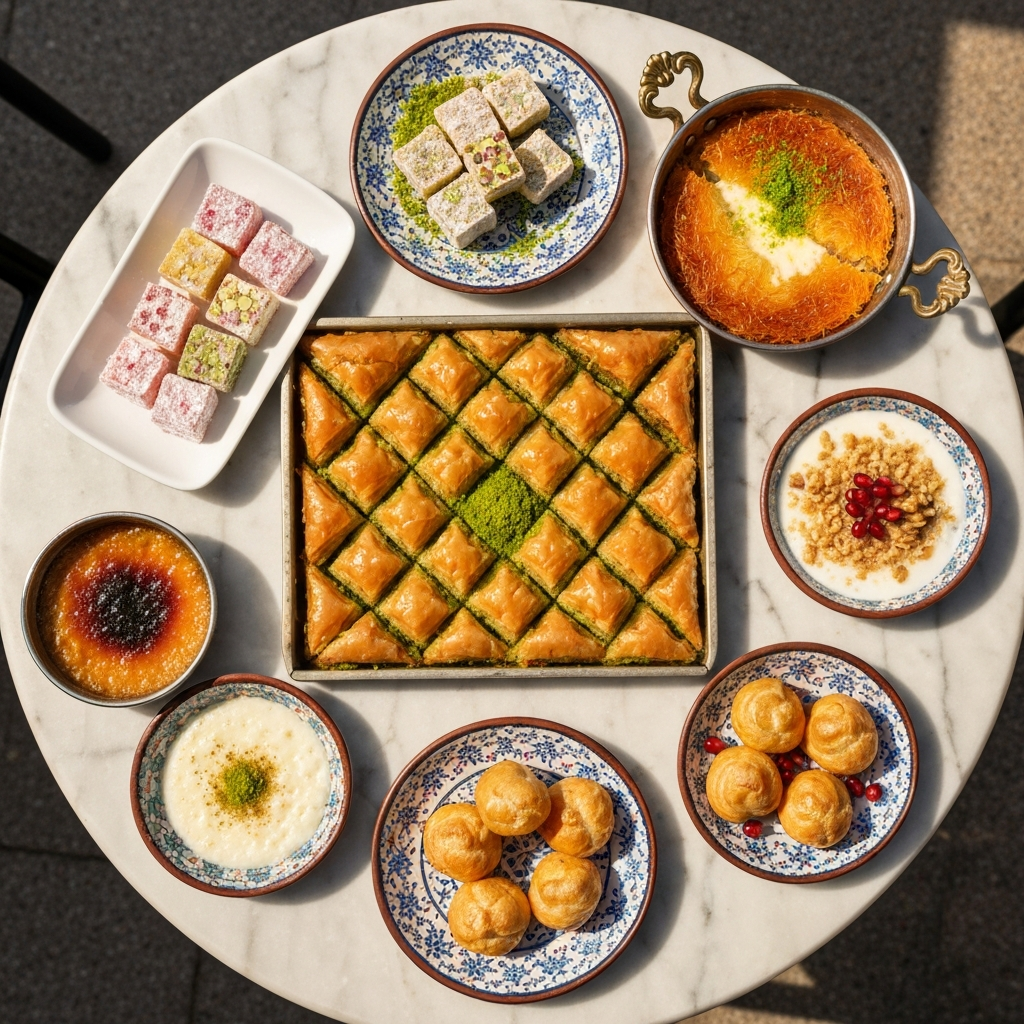
The shape of the Turkish dessert table
The Ottoman dessert tradition was codified in the palace kitchens of Topkapı in the 15th and 16th centuries — the same era when the same kitchens were also writing the rules of pilaf, kebab and soup that the wider Anatolian and Levantine world still follows. By the 18th century, an eastern-Mediterranean sweet vocabulary existed that had no exact parallel in the European tradition: it was built on phyllo and pistachio rather than on flour and chocolate, on the slow caramelisation of milk and rice and semolina rather than on whipped cream, and on flower-water aromatics (rose, orange blossom) rather than on vanilla. Today Istanbul holds, on the same square kilometre, the seven canonical Turkish sweets in their dynasty-level reference rooms — and a visitor who eats their way through them in the right order has a clearer map of Turkish cooking than they would get from a month of mains.
The seven canonical sweets, the categories the Istanbul pastry trade divides them into, and the eighth honorary entry that closes the table:
- Phyllo-and-syrup — baklava, şöbiyet, kadayıf, revani. The layered-pastry-soaked-in-sugar family.
- The starch-and-sugar set — lokum (Turkish delight). Cornstarch, sugar, water, flavour, set in a wooden tray and cut into cubes.
- Hot cheese pastry — künefe. Shredded kadayıf-style pastry baked in a copper pan with stretchy white cheese inside, finished with sugar syrup and ground pistachio.
- Milk puddings — kazandibi, sütlaç, keşkül, tavuk göğsü. The Ottoman dairy-and-rice repertoire, served cold in small porcelain dishes.
- Stretchy ice cream — Maraş dondurma. The salep-and-mastic- thickened Anatolian style cut with a knife, not scooped with a spoon.
- The Westernised hybrid — the Turkish profiterol. A 1940s Beyoğlu-pastane invention; small choux balls drowned in dark chocolate sauce.
- The fermented drink at the edge of the table — boza. Thick, lightly fermented millet, dusted with cinnamon, served with roasted chickpeas. Not quite a dessert; never not on the dessert table.
Each of the seven has at least one Istanbul room where it is done at the reference level. The sections below take them one at a time.
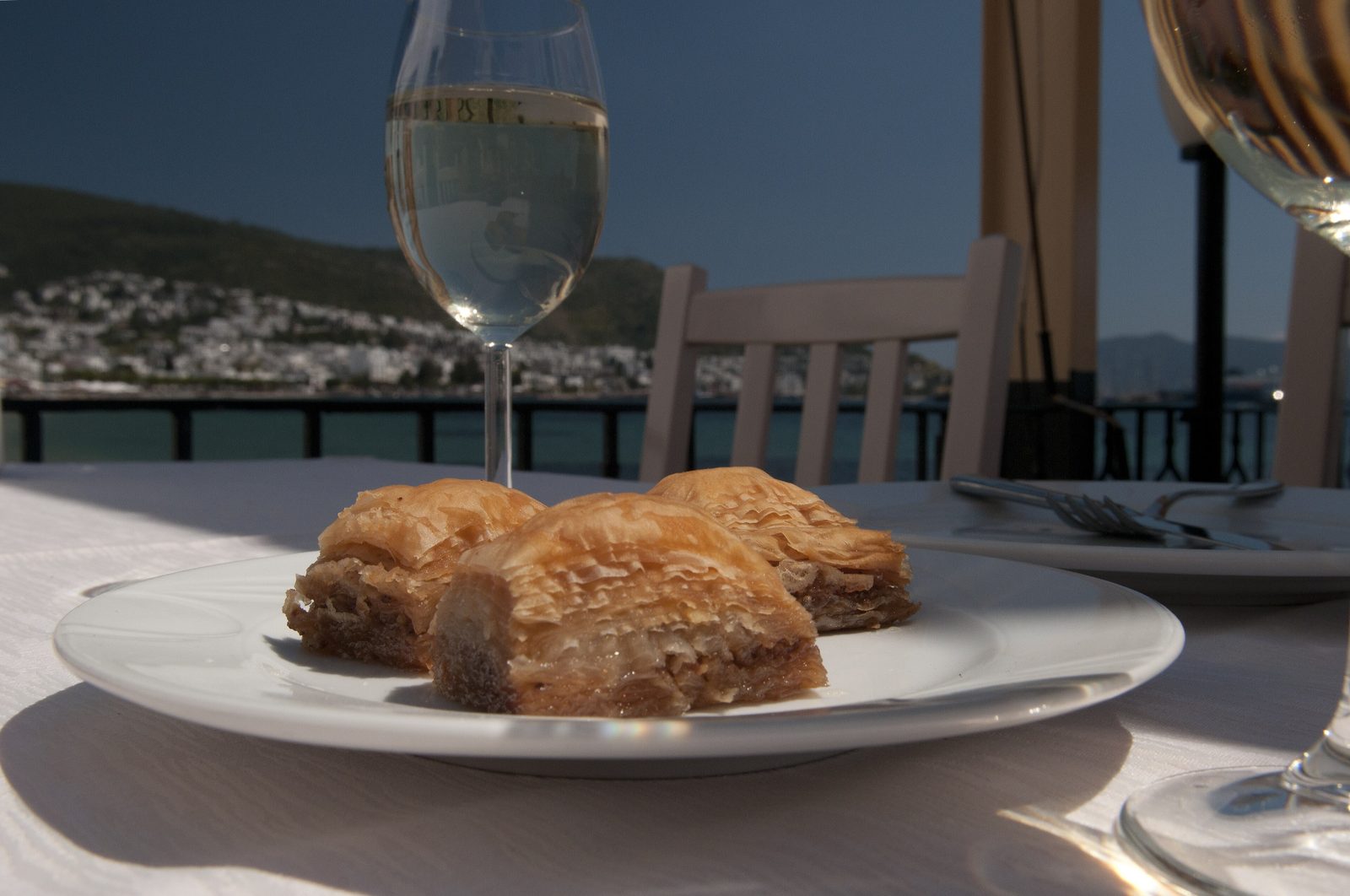
1. Baklava — the dynasty pastry
The single most-loaded sweet in the canon. Pistachio baklava at the dynasty level is built from forty hand-rolled layers of phyllo pastry, brushed with clarified butter, layered around a dense filling of milled Antep pistachio, baked until the top is golden, cut into perfect diamonds with sharp edges, and soaked in a thin sugar syrup poured hot. The finished piece is sharply caramelised at the top, soft and butter-saturated underneath, and holds its crisp diamond edge for about 36 hours before the syrup absorbs and the pastry softens. The half-life of a really good piece of baklava is shorter than that of an oyster.
The two reference rooms in Istanbul are both Gaziantep-tradition dynasties. Karaköy Güllüoğlu at Rıhtım Caddesi has held the Karaköy waterfront since 1949 — the Güllü family's Istanbul branch, run by the fifth generation of the 1871 Gaziantep dynasty, and the room that the city's pastry community treats as the benchmark. Walk up to the counter, order a half-kilo of the pistachio fıstıklı baklava, ask for it cut to the diamond, eat the first piece standing at the window with a small Türk kahvesi from the side counter. Hafız Mustafa 1864 (Sultanahmet) is the second house — the 1864-founded Ottoman patisserie dynasty that opened during the reign of Sultan Abdülaziz and has held a Sultanahmet branch ever since. The pistachio baklava is at the same level; the room is the gilded Ottoman-patisserie interior that the souvenir- shop Sultanahmet baklava counters tried to copy and never quite got right. Hafız Mustafa's Karaköy branch is the Bosphorus-walking-distance equivalent.
The full ranked baklava field — including the four-second test that separates the real thing from the souvenir-shop version, and the second-tier rooms worth knowing — is in the dedicated Best baklava in Istanbul blog post.
2. Lokum — the 1777 starch-and-sugar dynasty
The pale-pink rose-flavoured cubes dusted with powdered sugar that English speakers call "Turkish delight" — lokum in Turkish, literally "comfort" — is the soft, chewy, cornstarch-and-sugar confection invented in Istanbul in the late 18th century and exported to the rest of the world through the 19th. The technique is simple in outline (water, sugar, starch, and a slow simmer until the starch gelatinises and the mixture sets when poured into wooden trays) and exacting in execution (the slow simmer is six to eight hours, and the texture-temperature window is narrow enough that the city's good lokum-makers learned the craft from a parent who learned it from theirs). The dynasty texture is silky on the bite, slightly resistant in the middle, and releases the perfume of the flavouring (rose, pistachio, mastic, sour-cherry, pomegranate-molasses) on the second chew, not the first.
The two reference rooms are both 18th-century foundations. Ali Muhiddin Hacı Bekir, founded in Istanbul in 1777 by a confectioner from Kastamonu and still run by the seventh-generation Hacı Bekir family from its original Hamidiye Caddesi shop one block north of the Eminönü Mısır Çarşısı, is the older. The rose lokum and the pistachio-and-mastic version are the orders. The İstiklal Caddesi branch in Beyoğlu (No. 83) is the easier stop if you are walking down İstiklal anyway. Cafer Erol, founded in 1807 in Kandilli on the Asian Bosphorus and now based at its Muvakkıthane Caddesi shop in Kadıköy, is the other — slightly more boutique, with the extraordinary hand-shaped marzipan-fruit counter (tiny figs, peaches, and pears sculpted in marzipan) that is among the city's quietest visual pleasures. For the Sultanahmet-side boutique counterpart, Derviş Lokum in the streets behind the Blue Mosque (Küçük Ayasofya Caddesi) is the small-batch shop that offers generous tastings of unusual flavours — wild mastic, sour cherry, double pistachio, pomegranate-and-walnut. Buy a small mixed box on the way home; lokum keeps for months at room temperature in its dusted sugar. The What is lokum? primer has the longer treatment — the slow-cook technique, the six canonical flavours, why colour is the failure mode, and the 1777 Hacı Bekir origin that gave the dish its English name.
3. Künefe — the hot cheese pastry
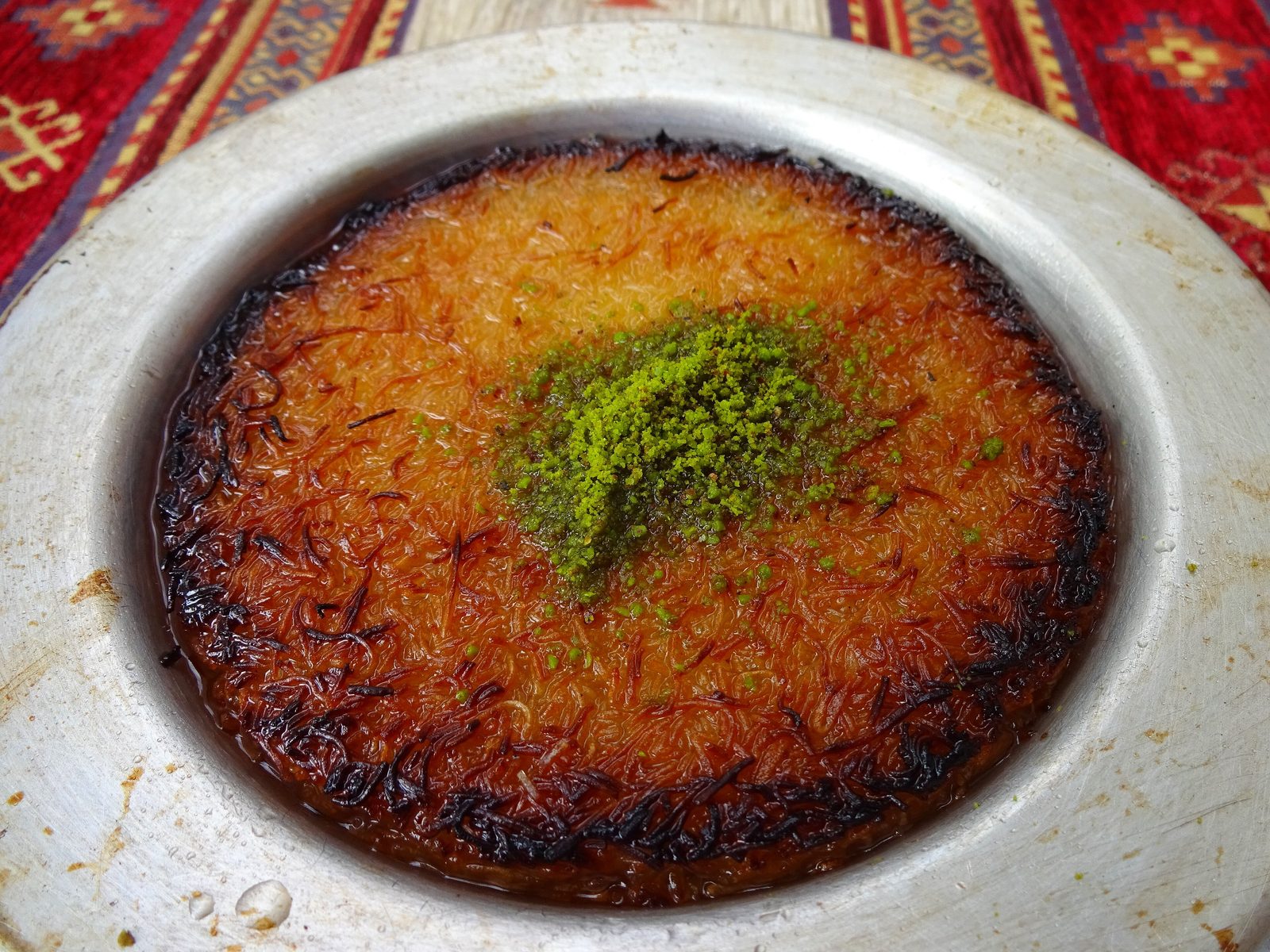
Künefe is the only Turkish dessert that is served hot from the oven and the only one structurally built around stretchy white cheese. The dish is southern-Turkey Levantine in origin (the Antakya / Hatay border region, where the same dessert is called knafeh in the Arabic-speaking half of the territory), and it arrived in Istanbul through the Ottoman administrative movements of the 19th and 20th centuries. The construction: a layer of shredded kadayıf pastry (the same fine angel- hair phyllo that the eastern-Mediterranean pastry trade uses for several other sweets) is pressed flat in a small individual copper pan, brushed with clarified butter, packed with a thick layer of unsalted stretchy white cheese (the Antakya peynir is specific and traditional; the Istanbul versions sometimes substitute a young Trabzon kolot for the same effect), and baked until the pastry is gold and crisp on top and the cheese inside is molten. The pan is brought to the table at the table; a hot sugar syrup is poured over from a copper jug; ground Antep pistachio is sprinkled across the top in a generous line.
The reference room in Istanbul is Hafız Mustafa 1864 (Sultanahmet), where the Ottoman-patisserie programme runs a künefe service from the early-evening onwards alongside the baklava counter — order one between two people, with a small Türk kahvesi to cut the sweetness. The first spoonful of künefe should have the cheese stretching in a thin glossy line between the pan and the spoon at full arm's length; if it doesn't, the cheese was wrong. Eat fast — the dish loses its texture inside six minutes. Long-form treatment of the Antakya origin, the cheese-stretch chemistry, and the four canonical Istanbul rooms is in the What is künefe? primer.
4. Kazandibi and sütlaç — the milk puddings
The Ottoman milk-pudding programme is the quietest of the seven traditions and the one most missed by visitors who arrive expecting "Turkish dessert" to mean only baklava and lokum. The five canonical milk puddings are each a single technique:
- Kazandibi — literally "bottom of the pot." A milk-and-sugar custard set with a small amount of rice flour, poured into a heavy pan, and deliberately caramelised on the bottom before being inverted so the scorched-caramel layer faces up. The finished pudding is pale cream with a deep golden-brown burnt layer on top — sweet, lightly bitter at the caramel line, the texture of set custard.
- Sütlaç — Turkish rice pudding. Whole milk, rice, sugar, and a scrape of vanilla simmered together, poured into small earthenware bowls, sometimes baked briefly under a broiler to produce a thin caramelised skin (fırın sütlaç, the oven version). Served cold or just-warm.
- Keşkül — almond milk pudding. Made with ground almonds rather than rice or cornflour, topped with crushed walnut and shredded coconut. Slightly grainy, lighter than sütlaç.
- Tavuk göğsü — the Ottoman court's most virtuosic single dessert: a milk-and-rice pudding into which finely-pulled poached chicken breast is incorporated so completely that no chicken texture or flavour remains, only an additional structural body. The Topkapı palace kitchen invented this in the 17th century. It is not for everyone, and it is also a small piece of edible history.
- Aşure (Noah's pudding) — a thick winter pudding made from cracked wheat, dried fruits, nuts and beans (literally Noah's-Ark provisions), served on the 10th of Muharram in the Islamic calendar. The Pudding Shop (Lale Restaurant) on Divanyolu — the cafeteria that opened in 1957 and became a legendary stop on the 1960s overland hippie trail — still runs the aşure on its cold-counter alongside kazandibi and sütlaç every day of the week.
Three reference rooms. Sütiş Pastanesi on Ihlamur Yolu in Beşiktaş is the Beşiktaş-anchored muhallebici chain whose original 1970s branch holds the full Ottoman repertoire from a long glass-fronted counter — kazandibi (the house specialty), sütlaç, keşkül, tavuk göğsü, and the oven-baked fırın sütlaç served still warm in its earthenware bowl. The closing stop on the Beşiktaş Morning Bites walking tour. Saray Muhallebicisi on İstiklal Caddesi (No. 102) is the long Beyoğlu-side counterpart — same repertoire, the 1950s-era room with the marble counter and the glass-domed pudding cases lit from below. The Pudding Shop in Sultanahmet is the historic-peninsula counterpart with the cafeteria-style service and the overland-route nostalgia.
5. Maraş dondurma — the stretchy ice cream
The single most photographed Turkish dessert on the internet, and the one most often seen in the wrong setting. Maraş dondurma — the stretchy, mastic- thickened, salep-flavoured Anatolian ice cream from the city of Kahramanmaraş in south-eastern Turkey — is structurally a different thing from European or Italian ice cream. The thickener is a combination of salep (the ground tubers of wild orchids; intensely flavoured, traditionally harvested from the Anatolian highlands) and natural sakız (Chios mastic). The result is dense enough that the vendor cuts it with a long knife rather than scooping it, holds it on the back of the knife at arm's length without dropping, and the customer eats it more slowly than a normal scoop — closer in mouthfeel to a soft mochi than to a gelato.
The Istanbul reference rooms are the Mado chain — the Maraş-tradition family dondurmacı dynasty with branches at Bebek on the European Bosphorus (Mado Bebek at Cevdet Paşa Caddesi No. 17) and at the southern end of İstiklal Caddesi in Beyoğlu (Mado (Beyoğlu)). Order it as a single plain salep-flavoured scoop with crushed pistachio on top; skip the chocolate-cookie variants. In summer the Bebek waterfront branch is the better setting; in winter, İstiklal — and yes, you eat dondurma in winter in Turkey too, because the salep flavour comes through more clearly when the ice cream isn't immediately melting on your spoon.
6. Profiterol — the Markiz invention
The one Turkish dessert that isn't Ottoman. The Istanbul profiterol — small choux- pastry balls drowned in a dark, slightly bitter chocolate sauce, sprinkled with crushed walnut and served cold in a long sundae glass — was invented in the 1940s at Markiz Patisserie on İstiklal Caddesi (No. 360), the Art Nouveau pastane that opened in 1940 in a building designed in the 1900s by the Levantine-Italian architects D'Aronco and Mongeri. The dish was a Westernised invention from the start: the choux comes from the French pastry vocabulary, the cocoa sauce from the same 1940s patisserie wave that brought eclairs and millefeuilles to Istanbul. What makes the Istanbul version distinct is the chocolate sauce — thicker and less sweet than the Western version, almost a hot fudge, poured generously enough that the choux pastry is fully submerged when the bowl arrives at the table. Eat it cold with a long spoon. The Markiz-period interior (the four large Art Nouveau ceramic-tile panels of the seasons by the French artist Arpad on the side walls) is one of the city's three handsomest patisserie rooms and a stop on the Beyoğlu Street Bites walking tour.
7. Boza — the 1876 honorary entry
Not strictly a dessert. Boza is a thick, lightly fermented millet drink with a distinct tangy-sweet flavour and a slightly cloudy pale-tan colour — a winter Anatolian speciality that lands on the dessert table at the end of long meals, served in a tall glass tumbler with a dusting of cinnamon on top and a small dish of roasted leblebi (chickpeas) alongside. The combination of the sweet-sour fermented drink and the salty crunchy chickpea is structural — neither half works without the other, and Turkish drinkers of every age handle the alternation between sip and crunch as a kind of small ritual.
The reference room is one room. Vefa Bozacısı at Katip Çelebi Caddesi No. 104, behind Süleymaniye in the old Fatih neighbourhood, opened in 1876 and has barely been altered since. The marble counter, the brass-and-glass jars, the century-old photographs on the wall, and the preserved tasting-glass behind glass that Atatürk drank from in 1937: all of it is still there. The boza is served from a refrigerated tap into the same kind of glass tumbler the room has used for a century. The What is boza? primer has the longer treatment — the fermentation question, the alcohol content, the seasonality and the ritual of how to drink the glass. The closing stop of the Sultanahmet Sweet Tooth walking tour — the dessert walk through the old city that sequences the seven sweets above into a single 2.5-hour afternoon arc.
The right order across a long weekend
The mistake most visitors make with Turkish desserts is treating them as a single category. They aren't — they are seven structurally different dishes that work best at different times of day, in different settings, and after different meals. A working sequence across a long Istanbul weekend:
- Saturday late morning — milk pudding to close kahvaltı. After the long Beşiktaş Çarşı Saturday breakfast, walk uphill to Sütiş Pastanesi for a kazandibi. The caramelised sugar pairs cleanly with the lingering salt of the kahvaltı table; the milk pudding is the right closer to a dairy-heavy morning. This is the closing move of the Beşiktaş Morning Bites walking tour.
- Saturday afternoon — baklava and Turkish coffee at Karaköy. Cross the Galata Bridge, walk up Rıhtım Caddesi, order a half-kilo of pistachio fıstıklı baklava at Karaköy Güllüoğlu, take it home in the paper box. The fıstıklı is the city's reference afternoon-coffee pairing.
- Saturday early evening — dondurma on the Bebek waterfront. Take the coastal road north to Bebek, order a plain salep-flavoured scoop at Mado Bebek on Cevdet Paşa Caddesi, eat it slowly along the waterfront with the Bosphorus open in front of you. Twenty minutes; the Bebek café row unspools from there.
- Saturday night — künefe and Türk kahvesi at Hafız Mustafa. After dinner, walk the Sultanahmet–Sirkeci block to Hafız Mustafa 1864 (Sultanahmet), order a single copper pan of künefe with ground pistachio on top, drink a small Türk kahvesi to cut the sweetness. The first spoonful should stretch.
- Sunday morning — lokum on the way home. Walk to the 1777 original branch of Ali Muhiddin Hacı Bekir on Hamidiye Caddesi at the Eminönü end. Buy a small wooden gift box of mixed lokum (rose, pistachio, sour cherry, mastic) to take home. The flight back is the right setting to eat the first piece.
- Sunday evening — profiterol on İstiklal. Walk down İstiklal Caddesi at golden hour, sit at Markiz Patisserie at No. 360 under the Art Nouveau ceramic panels, order a long sundae glass of profiterol with crushed walnut. The four seasons on the walls were designed by the French artist Arpad in 1900. The Markiz room is a stop on the Beyoğlu Street Bites walking tour.
- Sunday night — boza at Vefa. Close the weekend at Vefa Bozacısı, the 1876 fermented-millet institution behind Süleymaniye. One glass of boza dusted with cinnamon; a dish of roasted leblebi alongside. Twenty minutes; the room hasn't changed since the year it opened.
When to walk past
Walk past the souvenir-shop baklava counters along Divanyolu and the lower end of İstiklal that hold huge pre-cut diamond trays under fluorescent lamps. The baklava on display is typically 48 to 72 hours old, the syrup has fully absorbed and the pastry has gone soft, and the price is double what Karaköy Güllüoğlu charges for the actual-dynasty version. The four-second test (covered in the Best baklava in Istanbul post): a fresh diamond should hold its sharp-edged shape when picked up; if it sags or breaks, the syrup has already soaked through and the pastry is past.
Walk past the Sultanahmet-bus-tour-cafe "Turkish ice cream" theatre where a vendor in a tasseled fez pretends to take a cone away from a tourist before handing it over. The routine is real (dondurma's elasticity is high enough to support some of it), but it is also performed at venues whose actual dondurma is industrial supermarket-grade salep-extender ice cream rather than the Maraş family product. Walk to a Mado branch instead.
Walk past anything called "Turkish delight" sold loose, by weight, in the Sultanahmet souvenir corridors. Real lokum is sold in small dusted-sugar pieces in a wooden gift box or in the same dusted small bites at the 1777 / 1807 / 1864 family counters of Hacı Bekir, Cafer Erol, and Hafız Mustafa. The mass-tray pile is the same approximation that the pre-cut baklava is.
The short version
Baklava at Karaköy Güllüoğlu. Lokum at Ali Muhiddin Hacı Bekir on Hamidiye Caddesi. Künefe at Hafız Mustafa 1864 (Sultanahmet). Kazandibi and sütlaç at Sütiş Pastanesi on Ihlamur Yolu. Dondurma at Mado Bebek on the Bosphorus waterfront. Profiterol at Markiz Patisserie at İstiklal No. 360. Boza at Vefa Bozacısı, exactly where it has been since 1876. Seven sweets, seven rooms, three districts. The three-day Istanbul food itinerary sequences this dessert table alongside everything else worth eating in the city.
The full dessert list is in the app.
Every room named here, plus 230+ more venues across Istanbul — mapped, addressed, and walked offline. Free, no sign-in, no tracking.
Download free on the App Store