What is lokum (Turkish delight)?
Lokum is a slow-cooked Ottoman confection made from sugar syrup thickened with cornstarch into a soft, slightly chewy gel that's cooled, hand-cut into cubes, and dusted generously in powdered sugar. The English name "Turkish delight" entered the language in the 1830s when a London visitor bought a box from the Hacı Bekir shop in Istanbul; the Turkish word lokum derives from the Arabic rāḥat al-ḥulqūm ("comfort of the throat"). Real lokum is muted in colour, complex in flavour, and tastes of nothing like the industrial pastel-rainbow imitation most international travellers have eaten. Here is what the dish actually is, the canonical flavour family, why colour is the failure mode, and the four Istanbul rooms that get it right.
The short answer
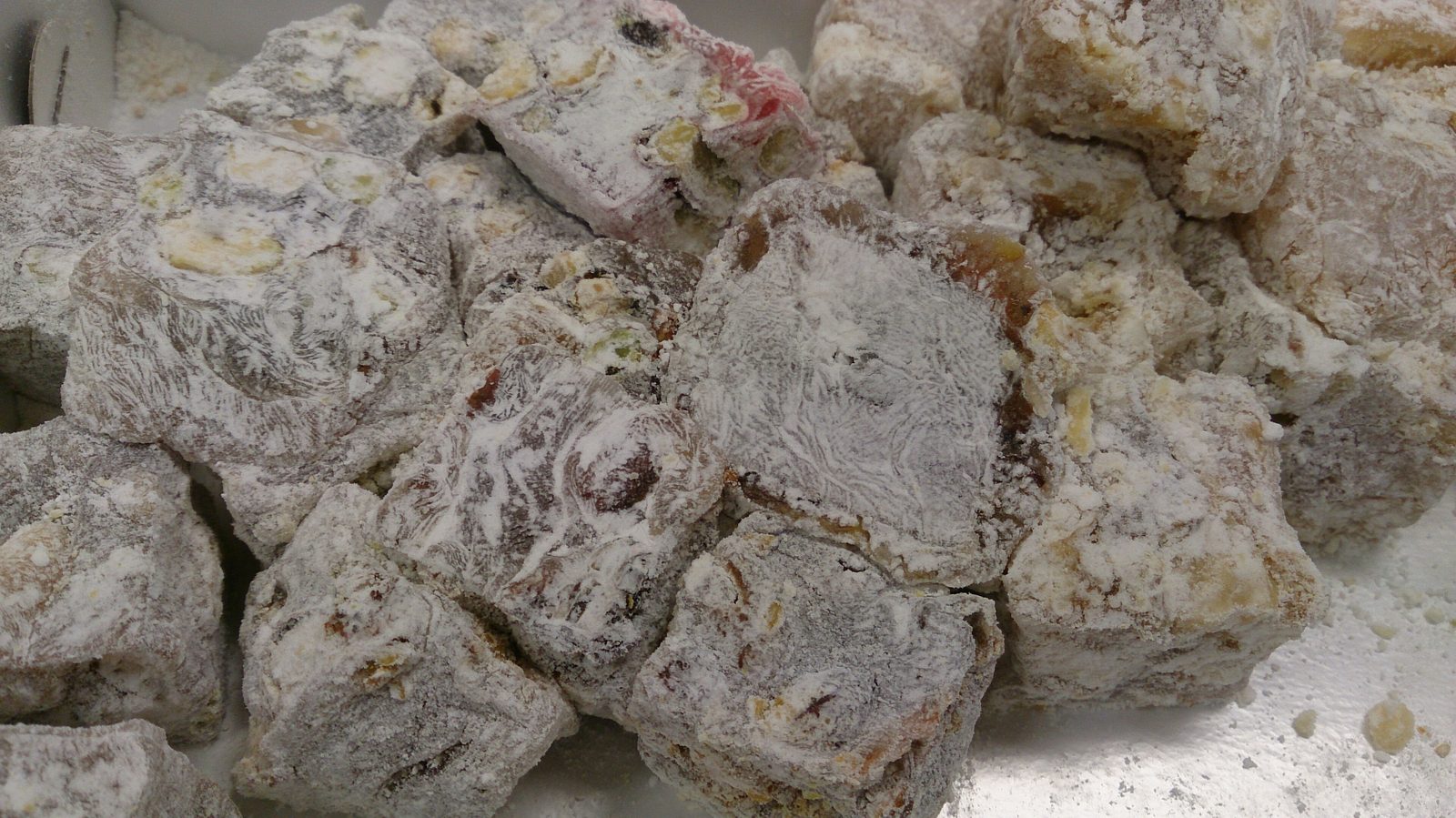
Lokum (pronounced lo-KOOM) is a sweet confection made from three ingredients: white sugar, water, and cornstarch — sometimes with a small addition of cream of tartar to soften the texture. The cook combines them in a heavy copper pot and stirs the mixture for one to two hours over low heat as the cornstarch hydrates and the sugar dissolves into a thick, translucent gel-like syrup. Flavourings and inclusions go in toward the end: rose water, mastic gum, crushed pistachios, walnut pieces, pomegranate molasses, cinnamon. The finished mixture is poured into a wide shallow tray dusted with powdered sugar and a thin coat of cornstarch, left to cool overnight to set firm, then hand-cut into roughly cubic pieces — typically a 2 cm cube — and rolled heavily in more powdered sugar to prevent the pieces sticking together.
The finished cube is soft enough that you can compress it slightly between thumb and forefinger, dense enough to hold its shape on a plate, and structured enough to cut cleanly with a knife. A good lokum is muted in colour — amber, walnut-brown, mastic-white, pistachio- green at the strongest — and the flavour is layered: you taste the cornstarch base, then the floral or nut flavouring, then the residual sweetness, in that order. Eat it with a Türk kahvesi orta (medium-sweet Turkish coffee) and the pairing is the classic Ottoman after-dinner closer.
The slow-cook technique — what real lokum is
The single most important detail in lokum is the duration and patience of the stir. The cornstarch-and- sugar mixture has to be brought slowly to a high enough temperature for the starch granules to completely hydrate and the sugar to invert into a glucose-fructose mix without crystallising — and held there, with constant stirring, for an hour or longer. A rushed cook produces lokum that's grainy in the teeth (incomplete starch hydration), too soft to hold its shape (incomplete sugar inversion), or hard and glassy (overheated sugar gone past the syrup stage). A serious lokum kitchen runs one chef whose entire job is the pot, stirring with a long-handled wooden spatula in slow figure-eights for the full cook time.
The cool-down is the second part of the technique. The finished syrup is poured into wide shallow trays — never deep ones — because the tray has to cool uniformly across its surface, and the cooling sets the gel structure. A poured tray rests for twelve to eighteen hours at cool room temperature before cutting. Rushed cooling produces lokum that's harder on the surface than the interior; properly cooled lokum yields uniformly soft cube-end to cube-end.
The hand-cutting is the third. After the tray sets, the cook scores the surface with a long knife, pushes the knife straight down into the gel in a grid, and lifts the resulting cubes out onto a powdered-sugar bed where they are dusted, rolled, and dusted again. A factory line uses a steel die to stamp uniform cubes; a hand-cutting room produces slightly irregular cubes, distinguishable by the small variations in size and the hand-sloped edges. The irregularity is a quality marker — not a defect.
The canonical flavour family
Six flavours form the Istanbul lokum canon. A serious confectioner runs all six, plus a small number of seasonal additions:
- Rose (gül). The oldest and the reference. A few drops of Anatolian rose water stirred in at the end of the cook produces a soft, floral, distinctly adult flavour that catches at the back of the nose. The colour is a muted pink-amber, never the bright pink of the industrial version.
- Mastic (damla sakızı). A small amount of crushed mastic resin from the Greek island of Chios, stirred into the syrup as it thickens. The flavour is resinous and faintly pine-like, with a cool finish on the palate. Mastic lokum is essentially colourless — pure cornstarch-white under the powdered sugar — and is the connoisseur's order.
- Pistachio (fıstık). Crushed Antep pistachios from south-eastern Turkey, folded into the syrup as it pours. The cubes are dense with visible green pistachio pieces and the flavour is nutty and slightly toasted from the kernel oil meeting the warm syrup. The premium version is çift fıstık (double-pistachio), with twice the nut by weight.
- Pomegranate molasses (nar ekşisi). A reduction of Anatolian pomegranate juice cooked down to a dark molasses, stirred in for a deep, slightly sour fruit flavour. The colour is a deep burgundy amber. A regional speciality of southern Turkish lokum tradition.
- Walnut (cevizli). Coarsely chopped Anatolian walnuts folded through the syrup. The most assertive of the nut versions, and the one that goes best with a strong Turkish coffee.
- Cinnamon (tarçınlı). A pinch of Anatolian Ceylon cinnamon stirred in at the end. Warmer and rounder than the rose version; an everyday winter order.
Seasonal additions include sour cherry (vişneli), fig (incirli), and sumac (sumaklı, a southern speciality). The combinations are also valid: rose-and-pistachio is the most-ordered single flavour in the Sultanahmet confectioners; double-pistachio with a cinnamon dusting is a Hafız Mustafa specialty.
Why industrial pastel-rainbow lokum is the fake
Almost every tourist shop in Istanbul sells lokum. Almost none of them sell the real thing. The industrial fake is unmistakable on sight: bright pink rose, neon yellow lemon, vivid green mint, rainbow-orange "fruit," all of it dyed with food colouring to compete for attention in illuminated display windows aimed at the cruise- ship crowd. Almost everything wrong with the industrial version is signaled by the colour — saturated, uniform, machine-stamped into geometrically perfect cubes, often filled with cream or jelly or, in the worst cases, gummy candy stuffed inside a thin lokum shell.
The flavour profile of the industrial version is the second tell. Real rose lokum tastes of rose water; industrial rose lokum tastes of artificial-rose flavouring run through a sugar syrup. Real mastic lokum tastes of pine resin and cool palate; industrial mastic is almost never on the menu because mastic doesn't read visually and won't sell. Industrial double- pistachio uses chopped processed pistachio nuts sold by weight; real double-pistachio uses fresh Antep pistachios shelled the day of cooking.
The simplest rule for a visiting eater is: walk past anything that looks bright. The canonical Istanbul lokum tray is muted in colour, dusted heavy in powdered sugar, and sold by weight at the counter, hand-cut to order from the day's tray. If you see neon pastels in an illuminated window display, the room is selling tourism rather than confectionery.
The 1777 origin — where Turkish delight entered English
Ali Muhiddin Hacı Bekir at Hamidiye Caddesi No. 83, Eminönü, opened in 1777 as a small confectioner's shop in the historic commercial district below the New Mosque. The shop's signature was the lokum it pioneered — slow-cooked in copper pots, rolled in powdered sugar, cut into irregular cubes, and sold from a marble counter. The story goes that an Englishman traveling through Istanbul in the 1830s bought a box from the Hacı Bekir shop, shipped it home to London, and described it to friends as "Turkish delight." The name caught. The shop is still open at the same address, in the same family, pouring the same recipe; the historic confectioner's display cases are themselves a small museum of nineteenth-century Istanbul sweet-making.
A walk-by visit to the Eminönü Hacı Bekir is on the way from the Spice Bazaar across to Sirkeci, and the visit itself is worth more than the box you'll leave with. Ask for the rose-pistachio combination by weight; pay at the counter; eat one piece outside the shop before you walk on. The Eminönü district guide has the wider geography of the Hamidiye Caddesi confectioner block.
Where to eat lokum in Istanbul
Four canonical Istanbul rooms, ranked by institutional weight:
- Ali Muhiddin Hacı Bekir — Hamidiye Caddesi No. 83, Eminönü. The 1777 founding shop. The reference room for the slow-cooked tradition.
- Hafız Mustafa 1864 — multiple branches in Sultanahmet (Hocapaşa Mahallesi Hüdavendigâr Caddesi No. 4, Divanyolu Caddesi No. 14) and on the Sirkeci side (Muradiye Caddesi No. 30). The second-oldest of the canonical houses, the wider menu of any of the four; runs the rose / pistachio / mastic canon plus a seasonal-fruit and a chocolate-coated version.
- Cafer Erol (Sultanahmet) — Alemdar Caddesi No. 5, Sultanahmet. The Sultanahmet branch of the 1807 Kadıköy dynasty, a small boutique programme with a particularly fine pomegranate-molasses version and the hand-sculpted marzipan fruits alongside. This is Stop 2 of the Sultanahmet Sweet Tooth walking tour.
- Derviş Lokum — Çadırcılar Caddesi No. 33, Sultanahmet, in the small atelier-block south of the Blue Mosque. Small-batch maker with the widest flavour-experimentation programme of the four rooms — wild mastic, sour cherry, pomegranate-molasses-dusted-in-pistachio, fig-and-walnut, and a seasonal sumac version that runs only in late summer. Stop 3 of the Sultanahmet Sweet Tooth tour. Tasting offered at the counter before you commit.
A note on geography: the four rooms are all on or near the historic peninsula — Eminönü, Sultanahmet, Sirkeci. The Sultanahmet Sweet Tooth tour walks Cafer Erol and Derviş Lokum in sequence inside an afternoon dessert arc that ends at the 1876 Vefa Bozacısı (see the What is boza? primer); the Eminönü Hacı Bekir is a short cross-Galata-Bridge walk west of those two. A morning at all four is possible and not excessive; allow time to browse rather than just buy.
What to drink with it
The canonical pairing is Türk kahvesi orta — medium-sweet Turkish coffee. The bitter coffee against the sweet lokum sets up a palate alternation that the after-dinner Ottoman tradition has been doing for centuries. A glass of strong black çay works for a lighter version of the same pairing. Avoid Western espresso (too acidic against the floral lokum) and definitely avoid tea with milk (the milk damps the powdered-sugar surface). The longer story on Turkish coffee is in the best-Turkish-coffee blog post.
How to tell hand-cut from industrial
Three tells. First, the colour: muted natural amber-rose-walnut tones are real; saturated pink-orange-green-yellow rainbow is industrial. No exceptions.
Second, the cube shape: real hand-cut lokum has irregular cubes with slightly sloped edges and small size variations from piece to piece. Industrial lokum is geometrically perfect — every cube the same size, every edge sharp at ninety degrees, machine-stamped from a die.
Third, the dust coat: a serious confectioner rolls each piece in powdered sugar generously enough that the surface of the finished cube is almost completely white. The cube reveals its underlying colour only when you bite it open. An under-dusted cube is one that's been sitting on a display shelf for weeks; an over-saturated-colour cube is one that's been dyed instead of flavoured. The powdered-sugar dust is the visible signature of fresh production.
What's next
Lokum sits inside the wider Ottoman sweet tradition covered in long form by the best-Turkish-desserts blog post, where it appears as one of the seven canonical Turkish sweets (baklava, lokum, künefe, kazandibi, sütlaç, dondurma, profiterol). The Sultanahmet Sweet Tooth walking tour walks two of the four canonical lokum rooms (Cafer Erol and Derviş Lokum) as Stops 2 and 3 of an afternoon-into-evening dessert arc through the old city. The Sultanahmet district guide has the wider geography of the Ottoman confectioner block.
Every lokum room above is in the app.
The 1777 Hacı Bekir, Hafız Mustafa 1864, Cafer Erol Sultanahmet, Derviş Lokum — plus 230+ other hand-picked Istanbul venues — mapped, addressed and walked offline in the free Taste Istanbul app. No tracking pixels, no third-party analytics. Free, no sign-in.
Download Taste Istanbul on the App Store