Home › Blog › Best Turkish coffee in Istanbul: the 460-year history, where to drink it now
Best Turkish coffee in Istanbul: the 460-year history, where to drink it now
Istanbul opened the world's first commercial coffeehouse in 1554. The 1871 roaster the city still queues outside is a five-minute walk from where that coffeehouse stood. And Istanbul's third-wave specialty-coffee renaissance — the one that gave Western Europe much of its current café style — started in 2012, four hundred metres downhill on the same street. The full arc, ranked and explained, with the named addresses for each tradition today.
By Sadettin Köseoğlu · 12 May 2026 · 10-minute read
What Turkish coffee actually is
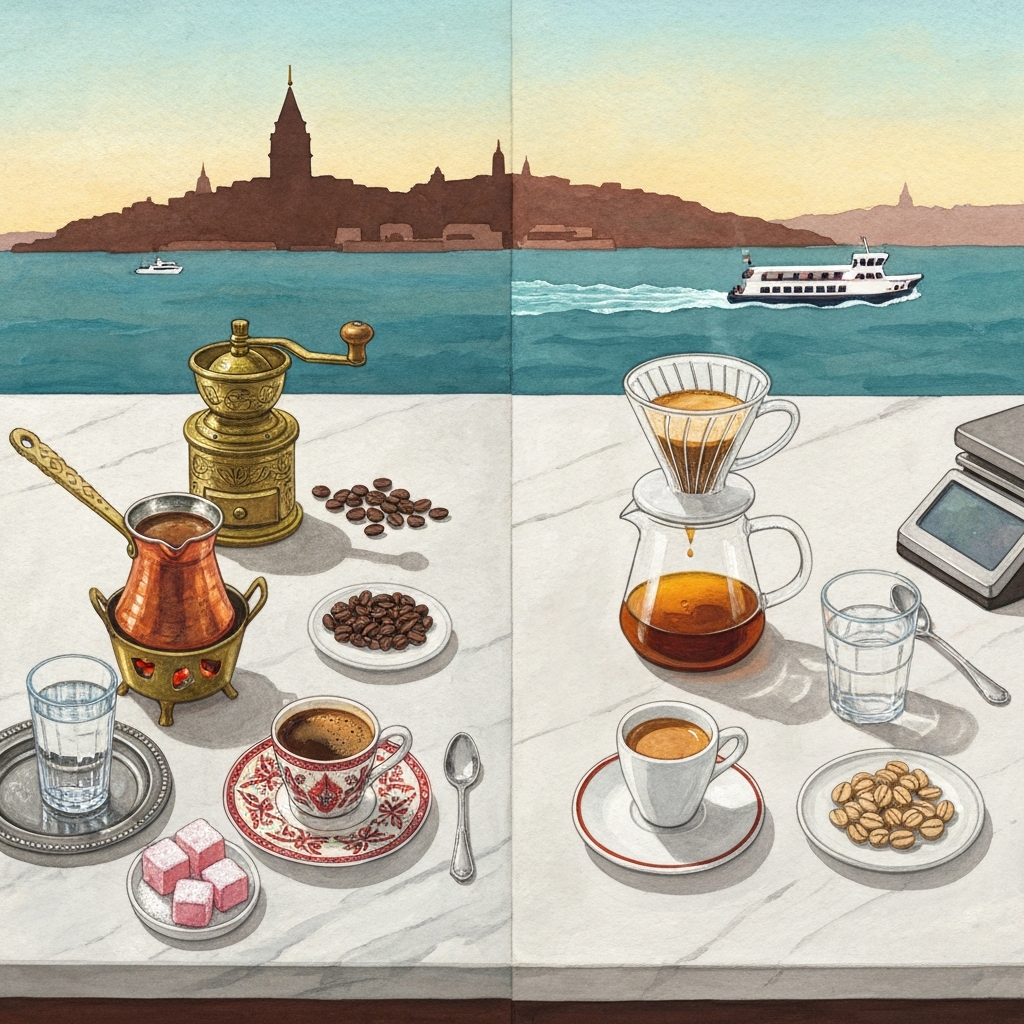
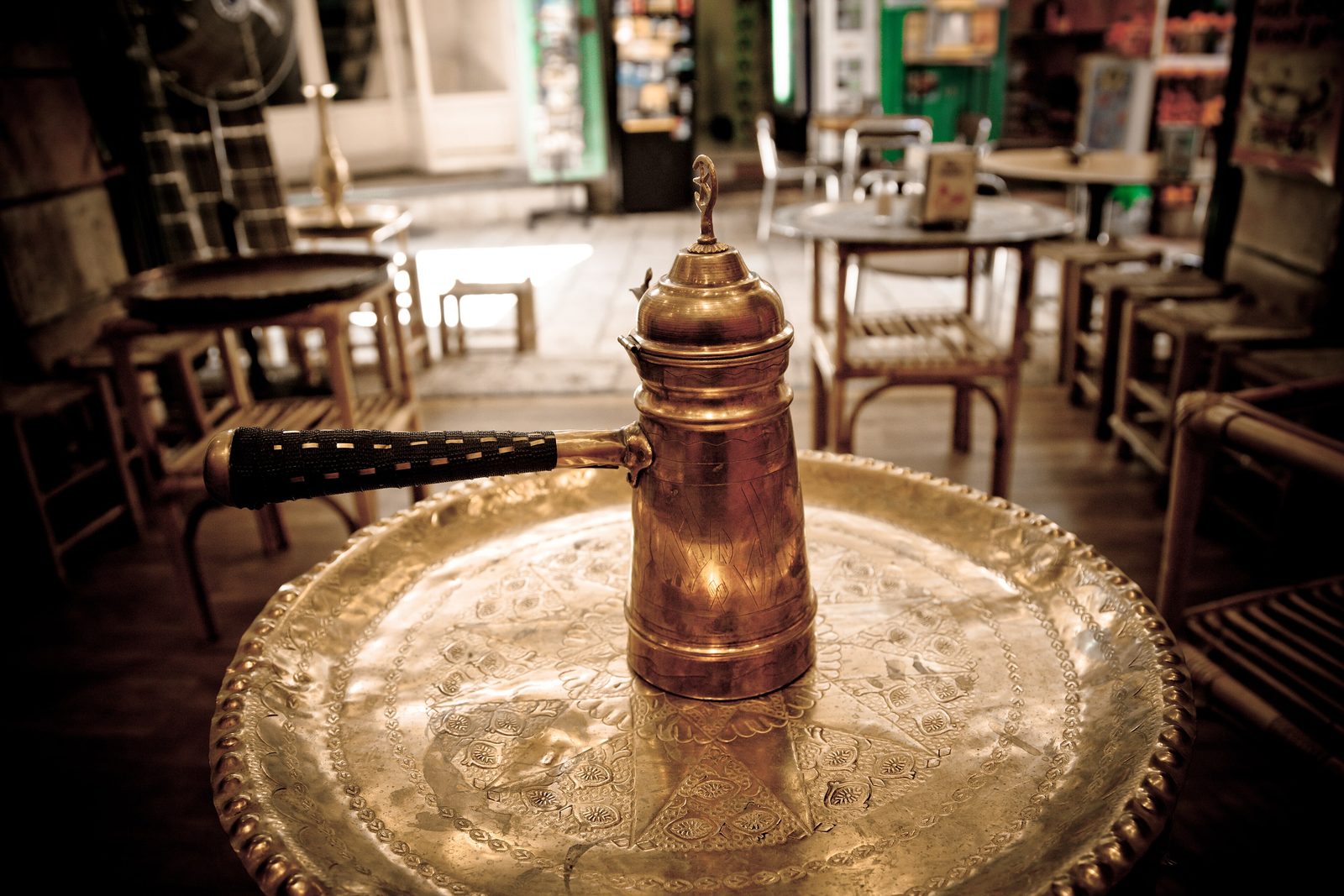
Türk kahvesi — Turkish coffee — is a brewing method more than it is a single drink. Finely ground coffee (closer to icing-sugar texture than to espresso grind), cold water, and sugar (or not, depending on how you order it) are combined unfiltered in a small long-handled copper pot called a cezve, brought slowly to the edge of a boil over very low heat — traditionally over hot sand or a small charcoal brazier, modernly over a gas ring — and poured into a small porcelain demitasse along with the grounds. The defining feature is the köpük, the pale tan foam that rises to the top of the pot just before it boils and that the experienced coffee-maker carefully spoons into each cup first. The coffee is sipped slowly, never stirred (the grounds settle at the bottom), paired with a small glass of cold water (drunk first, to clean the palate) and a piece of lokum (Turkish delight, taken between sips). The grounds at the bottom of the cup are read for fortune- telling (fal) by anyone who claims to know how, which is most people over fifty.
What Turkish coffee isn't is a single beverage that has stayed identical for five hundred years. The roast, the grind, the brewing temperature, the sweetness, the social setting, and even the cup have all moved through several distinct eras since the first coffeehouse opened in Istanbul in 1554. Knowing the arc is the difference between drinking a tourist-trade Turkish coffee in a Sultanahmet hotel lobby and drinking the actual cultural object on a side street in Eminönü, and the difference is roughly the same as the gap between an instant Nescafé and a single-origin V60 pour-over.
1554: Istanbul invents the coffeehouse
Coffee as a drink came to Istanbul from Yemen and Egypt in the mid-1500s — Sufis on the Hejaz pilgrimage route brought it back as a stimulant for late-night devotional practice. But the institution of the coffeehouse — a public room you walked into, paid for a small cup, sat at a low table, and stayed for hours to read, argue, gamble, play backgammon, listen to a story-teller, or just sit — was invented in Istanbul in 1554, when two Syrian merchants named Hakem and Şems opened the city's first kahvehane in the Tahtakale neighbourhood near the Eminönü waterfront.
Within a decade there were hundreds of coffeehouses in Istanbul, and the institution had spread through the Ottoman Empire — Damascus, Cairo, Aleppo, the Hejaz — and then, via Venetian merchants in the late 1500s and through Vienna in 1683, into the rest of Europe. The Viennese, the Parisian, the London and the Bostonian coffeehouse all descend, with no missing links, from the 1554 Tahtakale original. The street name Tahmis Sokak in Eminönü — "tahmis" means "roasting place" in Ottoman Turkish — preserves the trace of this beginning today: the lane is where the city's coffee was traditionally roasted and ground for the surrounding kahvehanes, and it's where, four centuries later, one of those roasters is still in business.
1871: the Mehmet Efendi pivot
For three centuries the Istanbul coffee trade ran through raw-bean importers and street-corner roasters. In 1871, Mehmet Efendi, the son of an established Eminönü coffee trader, opened a small shop on Tahmis Sokak that did something nobody had bothered with before: he roasted, ground, and packaged Turkish coffee for the home cook, ready to brew in the cezve without the customer needing to find a separate roaster and grinder. The convenience travelled. The shop became Kurukahveci Mehmet Efendi — literally "Mehmet Efendi the dry-coffee seller" — and is still on the same Tahmis Sokak address a hundred and fifty-four years later, run by the same family, queueing out the door every weekday.
The reason to visit Mehmet Efendi today isn't a cup of coffee on premises — the shop has a small counter at the side where you can drink a brewed cup while you queue, but the room isn't a café; it's a retail roaster. The reason to visit is to buy a quarter-kilo of the medium- ground Turkish-coffee blend in the iconic red-and-cream paper packet (the design has barely moved since the 1950s) to take home and brew yourself. The brass grinders behind the counter have not changed in a century. The roast is medium-dark, the grind closer to flour than to powder, and the resulting cup, brewed in a cezve on a low flame, is the closest thing in 2026 to the coffee that Istanbul drank in 1900.
1985–2010: the gap
Through most of the late 20th century, Istanbul coffee culture went quiet. The Nescafé generation took over in the 1980s — the bright-red sachet of instant coffee became the default at home and in offices — and the rise of Italian-style espresso bars in the 1990s and 2000s largely bypassed the Turkish-coffee tradition rather than building on it. Espresso machines arrived from Italy, baristas trained in Milan, and the resulting cafés were Italian cafés that happened to be in Istanbul. Real Turkish coffee retreated into homes, grandmother's kitchens, and a few stubborn neighbourhood kahvehanes that the under-30 crowd mostly stopped going to. There was a quarter-century when the most coffee-obsessed city in the world wasn't doing much of interest with the drink it had invented.
2010 onwards: the Karaköy specialty-coffee renaissance
The third-wave specialty-coffee movement — the San-Francisco-and-Melbourne-led shift toward single-origin beans, light roasts, careful extraction, and the V60 pour-over as a serious brewing method — arrived in Istanbul around 2010, and it arrived almost entirely through one neighbourhood: Karaköy. Within five years a quarter-kilometre of cobbled streets at the foot of the Galata Tower contained more specialty roasters per square metre than any other district in Europe.
Kronotrop Coffee Bar on Karanfil Aralığı (later expanded to a larger room on Mumhane Caddesi) was the first; it opened in 2012 and is generally credited with starting the wave. Coffee Department on Mumhane Caddesi followed within a year — a competition-style brew bar with four pour-overs running in parallel and a wall of single-origin beans behind the counter. Petra Roasting Co. on Bankalar Caddesi roasts on premises with an Italian Probat drum visible through the window and runs the most serious filter-coffee list in the neighbourhood. Mums Coffee Roastery a few streets up pours the strongest espresso in Karaköy by a fair margin. The four roasters together export beans across Europe now, and several have opened second locations in Istanbul; Coffee Department Kadıköy across the Bosphorus in Yeldeğirmeni is the Asian-side sister to the original, and one of the city's first proper espresso bars.
The Kadıköy Asian-side specialty scene grew up roughly in parallel. Federal Coffee Company in Moda runs a brighter, brunchier room that does pour-overs and a serious filter list. Karabatak Kadıköy on Bahariye Caddesi is a sister of the Karaköy original and pours one of the better espressos on the Asian side. Komşu Fırın in Yeldeğirmeni — a wood-fired sourdough oven that doubles as a coffee room — runs the rare combination of a great espresso and the actual bread to eat with it. The Asian-side scene is quieter, more local, and the rents are lower; many of the city's best baristas have ended up there in the last five years.
Where to drink each tradition today
Classical Turkish coffee — the kahvehane and the historic counter
Three places to drink a classical türk kahvesi in Istanbul that are not tourist- trade hotel lobbies.
Kurukahveci Mehmet Efendi on Tahmis Sokak in Eminönü — the 1871 retail roaster. Queue out the door for a quarter-kilo of beans to take home, and drink a small cup at the side counter while you wait. The cup is not the room's primary product; the bag of beans for your own cezve is. (See the Eminönü district guide for the full context on Mehmet Efendi and the surrounding Tahmis Sokak block, and the Eminönü Fish & Spice Trail walking tour for the three-hour sequence that has Mehmet Efendi as Stop 3.)
Sirkeci Konak Kahvesi on Taya Hatun Sokak in Sirkeci — a small Ottoman-style coffeehouse a few minutes from the historic Sirkeci railway station. Low brass tables, kilim cushions, a charcoal brazier where the cezve is brewed in front of you, and a small piece of pink rose lokum on the saucer. The setting is intentionally historicist — this isn't a 16th-century survivor — but the room is the closest thing in the old city to drinking coffee the way a 1900 Istanbullu would have drunk it. Drinkable any time from morning to late evening.
Saray Muhallebicisi (Üsküdar) on Hakimiyet-i Milliye Caddesi — the Asian-side milk- pudding institution, with a long Ottoman-style coffee list at the back of the menu. The combination of a cardamom-rich Turkish coffee with a piece of warm kazandibi (caramelised milk pudding with a thin scorched crust) is the meal worth coming for. See the Üsküdar district guide for the surrounding neighbourhood.
Bosphorus-view classical coffee — the tea garden ritual
The classical waterfront-tea-garden ritual is mostly associated with çay, but a Turkish coffee at any of the Asian-side waterfront cafés works equally well if you prefer the bitterer drink. Çınaraltı Çay Bahçesi in Çengelköy is the most beautiful of the lot — a small painted garden under a four-hundred-year-old plane tree on the Bosphorus shore, Turkish coffee served in a small porcelain cup on a brass tray. Büyük Çamlıca Çay Bahçesi at the top of Büyük Çamlıca hill runs the panoramic version with a view of all seven hills of the historic peninsula. Both are covered in detail in the Üsküdar district guide.
Third-wave specialty coffee — Karaköy
The four addresses that defined the Karaköy renaissance are all within a five-minute walk of each other and each runs a slightly different style.
Kronotrop Coffee Bar on Mumhane Caddesi for the city's reference single-origin filter coffee — the V60 pour-over is the order to make, the rotating bean board is worth reading before you choose, and the small cake counter handles the food side. Coffee Department a few doors down for the competition-style four-pour-overs-at- once brew bar — the baristas will tell you exactly what's in each cup. Petra Roasting Co. on Bankalar Caddesi for the on-premises-roast story, where you can see the drum behind the bar and ask to taste whatever just came off it. Mums Coffee Roastery a few streets up for the strongest espresso in the neighbourhood. All four are part of the Karaköy Meze Trail walking tour at Stop 3, where Kronotrop is the named coffee break in the sequence.
Third-wave specialty coffee — Kadıköy
The Kadıköy Asian-side specialty scene is quieter and more local than Karaköy, and on a busy weekend afternoon arguably the better visit. Coffee Department Kadıköy in Yeldeğirmeni is the Asian-side sister of the Karaköy original and one of the city's first proper espresso bars. Federal Coffee Company in Moda runs a brighter, brunchier room with a serious filter list. Karabatak Kadıköy on Bahariye Caddesi pours one of the better espressos on this side of the water. And Komşu Fırın in Yeldeğirmeni is the wood-fired sourdough bakery that also pulls a serious espresso — the rare combination of an excellent espresso and the actual bread to pair it with. The Kadıköy district guide has the full Asian-side coffee story alongside the market walk.
How to order a classical Turkish coffee
A correct order at any classical kahvehane is one short phrase that tells the brewer how much sugar to add at the start of the brew (you can't add sugar after — the grounds are already in the cup, and stirring would destroy the foam):
- Sade — no sugar. The bitterest, cleanest version. The default for serious coffee drinkers.
- Az şekerli — lightly sweet. About half a teaspoon of sugar per cup.
- Orta (or orta şekerli) — medium-sweet. One full teaspoon. The most common order in Turkey.
- Çok şekerli — very sweet. Two teaspoons. Common at weddings, where sweet coffee is part of the welcome ritual.
The traditional pairing is a small glass of cold water (sip first, to clean the palate before the coffee) and a piece of lokum (Turkish delight, taken between coffee sips). If the room offers it, ask for the rose-flavoured pink gül lokumu; the pomegranate or the pistachio version are also correct. Don't stir the coffee. Don't drink the last sip — the grounds settle into a thick paste at the bottom of the cup, traditionally turned over onto the saucer for the fal (fortune-reading) when the cup has cooled.
When to walk past
Walk past anything that calls itself a "Turkish coffeehouse" in a Sultanahmet hotel lobby and presents a tray of perfectly identical brass cezves on a silver tray with a $12 price tag — the coffee is likely serviceable, but the room is theatre rather than the actual cultural object, and the same cup costs eight lira at Kurukahveci Mehmet Efendi's side counter fifteen minutes downhill. Also walk past the multilingual-laminated-menu cafés on Divanyolu Caddesi or İstiklal Caddesi that advertise Turkish coffee with fortune-telling on a sandwich board outside the door — the coffee will be drinkable, but the room is a packaged one, and the city's real specialty-coffee renaissance and the real historic Turkish coffee tradition both live two neighbourhoods away.
How to pair this into a trip
A working sequence for a coffee-heavy Istanbul afternoon — borrowing the structure of the Istanbul Specialty Coffee Crawl in the app:
- 11 am — Karaköy. Start at Kronotrop Coffee Bar on Mumhane Caddesi. A single-origin V60 pour-over. Read the bean board, talk to the barista, smell the cups.
- 12 pm — across the Galata Bridge. Walk over to Eminönü. Queue at Kurukahveci Mehmet Efendi on Tahmis Sokak. Buy a quarter-kilo of medium-ground Turkish coffee for the cezve at home; the iconic red-and-cream packet ships well as a gift. A small Turkish coffee at the side counter while you wait.
- 2 pm — across the Bosphorus. Take the ferry from Eminönü or Karaköy to Kadıköy. Twenty minutes; a glass of çay on board. The crossing is the deliberate pause in the day.
- 3 pm — Yeldeğirmeni. A second specialty stop at Coffee Department Kadıköy for an espresso or at Komşu Fırın for the sourdough-and-espresso pairing. Two contrasting Asian-side rooms within five minutes of each other.
The full Istanbul Specialty Coffee Crawl tour landing page has the five-stop sequence (Kronotrop → Petra Roasting Co. → Federal Coffee Company → Mehmet Efendi → Coffee Department Kadıköy) with addresses, timings and the Bosphorus-ferry crossing instructions. See the walking-tours meta-guide for where it sits in the sixteen-tour catalogue.
The short version
Istanbul invented the modern coffeehouse in 1554. The 1871 retail roaster that quietly turned Turkish coffee into something you could brew at home is still on the same Eminönü street — Kurukahveci Mehmet Efendi. The twenty-first century's third-wave specialty-coffee renaissance arrived back in Istanbul in 2010 and lives in Karaköy and Kadıköy — Kronotrop, Coffee Department, Petra Roasting Co., Mums, Federal Coffee Company, Karabatak Kadıköy, Komşu Fırın. The classical-room counterpart, brewed on a charcoal brazier and served with rose lokum, lives at Sirkeci Konak Kahvesi in Sirkeci and Saray Muhallebicisi in Üsküdar.
Order one sade. Drink it slowly. Don't stir.
The full coffee crawl is in the app.
Five stops, mapped, with the one or two specific things to order at each. Free, offline, no sign-in. Plus 230+ more venues across the rest of the city.
Download free on the App Store