Home › Blog › Best baklava in Istanbul, ranked and explained
Best baklava in Istanbul, ranked and explained
Three places worth crossing the city for, what to ask for at each counter, and the four-second test that separates the real thing from the souvenir-shop version.
By Sadettin Köseoğlu · 8 May 2026 · 7-minute read
What baklava actually is
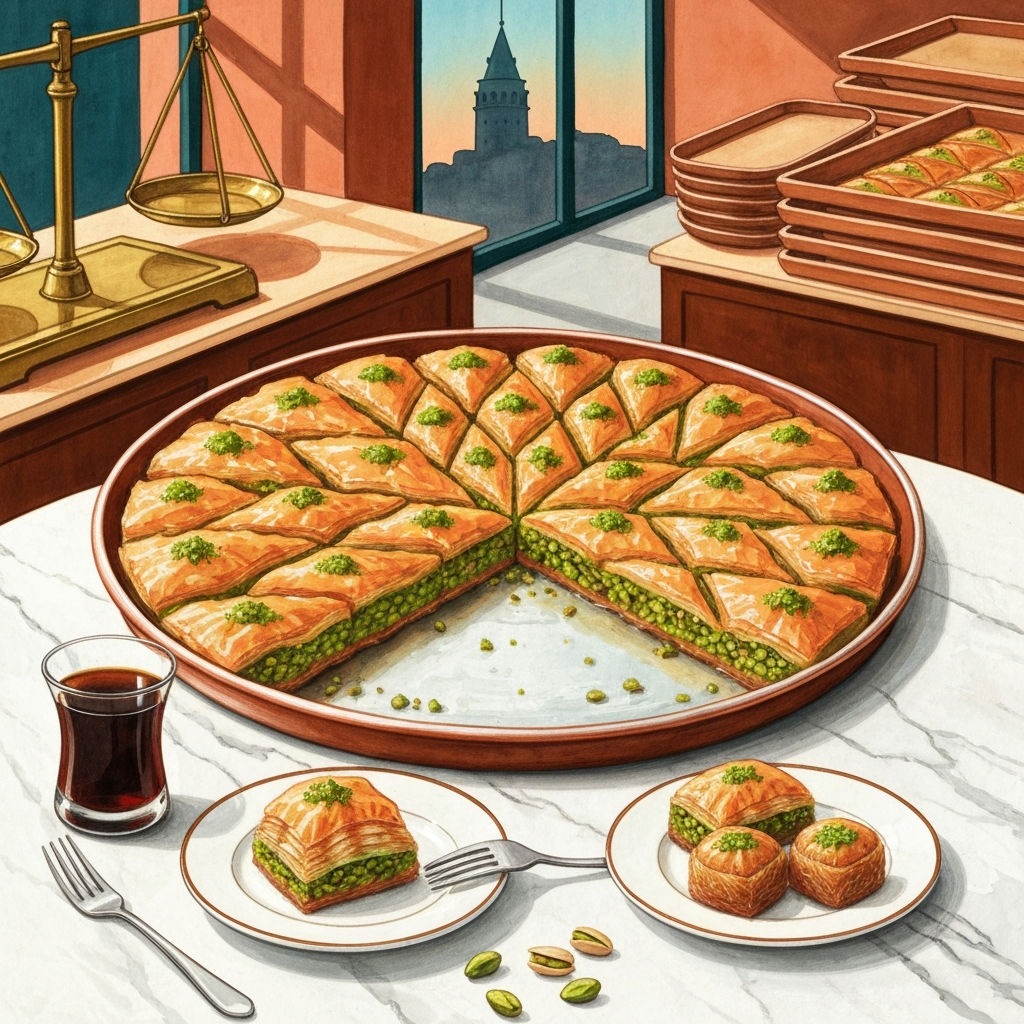
Baklava is a layered pastry of paper-thin yufka sheets, brushed with clarified butter, packed with ground nuts (in the Turkish tradition, almost always pistachios from Gaziantep in the southeast), baked until the crust shatters, then drenched in a light sugar syrup. Six or seven materials in total. Done well, it is one of the most technically exact desserts in any cuisine. Done badly — which is most of the time, in most of the world — it is sticky, cloying, and easily mistaken for confectionery.
The Turkish-style baklava you'll find in Istanbul is not the dense, walnut-heavy, honey-syrup version common across the Balkans and the Levant. It is drier in the syrup, lighter in the layering, much more aggressive on the pistachio, and finished with a brilliant green pistachio crumb on top that's the colour of fresh grass. The yufka is made by hand in a baklava workshop — a baklavacı — by a master who can stretch a single sheet to less than a hundredth of a millimetre. There is no machine equivalent. The workshops that don't make their own yufka can be spotted in three seconds.
The four-second test
Before you order, look at the tray. Four things to check, in this order:
- The pistachio colour. The crumb should be a brilliant emerald-to-grass green. If it's pale, yellowed, brown-tinged, or — most damning — has turned to khaki, the nuts are old, oxidised, or not from Gaziantep. Walk past.
- The crust colour. A deep, slightly uneven gold. Not pale (under-baked). Not dark brown (over-baked or made with too much sugar in the wash, a common shortcut).
- The shimmer. The top layer should glisten faintly with syrup but not look wet. A pool of syrup at the bottom of the tray means too much syrup has been used to mask thicker yufka.
- The cut. A baklavacı cuts in diamond and square portions before the bake, and the cuts should be sharp at every edge, all the way down to the bottom layer. Soft edges are a sign of poor knife work or a tray that has been sitting too long.
Four seconds, three of which are the colour inspection. If the tray fails any of them, the counter staff already know — they just hope you don't.
The three places worth crossing the city for
1. Karaköy Güllüoğlu
Where: Karaköy, Mumhane Caddesi · The European-side reference.
The Güllü family has been making the same baklava in the same workshop since 1949 and has been the reference baklavacı for the European side for the entire post-war period. Paper-thin yufka layered by hand with clarified butter and Gaziantep pistachios. The pistachio crumb is the brightest emerald you'll see anywhere in the city. The trays come out of the oven at 10am and peak between 11 and noon — go in the morning, eat one standing at the counter, take a small box with you. Order:
- Fıstıklı baklava — the classic pistachio.
- Burma — the rolled version, where the pistachio is wrapped inside a single coiled sheet and the syrup soaks in differently. Crisper.
- Şöbiyet — bite-sized triangles filled with kaymak (clotted cream) and pistachio. The richest item on the counter.
- Sütlü nuriye — the unusual sister, made with sweetened milk instead of syrup. Less sweet, more delicate, a fair-weather alternative for anyone who finds standard baklava too much.
2. Hafız Mustafa 1864
Where: Sultanahmet, Hocapaşa Mahallesi · The Sultanahmet dynasty.
Hafız Mustafa is older than Karaköy Güllüoğlu by nearly a century — founded during the reign of Sultan Abdülaziz in 1864 — and runs multiple branches across the historic peninsula, with the Sirkeci flagship near the historic train station being the original. The interiors are jewel-box Ottoman: brass lamps, marble counters, glass cases stacked with diamond-cut trays under spotlights. The pistachio is excellent (though not always quite as bright a green as Güllüoğlu's, in side-by-side); the differentiator is the wider range of Ottoman confectionery: candied fruits, rose-flavoured marshmallow, hand-cut lokum, the full marble-and-brass spread. Order baklava if you came for baklava, but stay for the rest of the counter.
3. Güllüoğlu (Üsküdar)
Where: Üsküdar, Hakimiyet-i Milliye Caddesi · The Asian-side annex.
The Asian-side branch of the Güllü family — fresh pistachio baklava arrives daily from the Karaköy workshop. If you're already on the Asian side after a long Kadıköy market morning and don't want to cross back, the Üsküdar Güllüoğlu serves the same baklava as the Karaköy original. The room is plainer; the pastry is identical. Worth knowing if you're staying in a hotel on the Asian shore or planning a single day across both Üsküdar and Kadıköy without a ferry detour to Karaköy.
What to walk past
Three categories are reliably bad in Istanbul, and unfortunately are also the most visible to a first-time visitor:
- Souvenir-shop baklava in Sultanahmet. The shops near the Blue Mosque selling pre-packed boxes of rainbow-coloured pieces with neon green icing on top — that green is dye, not pistachio. The crumb underneath is almost always ground walnut and food colouring. Walk past.
- Hotel-buffet baklava. Almost every Istanbul hotel buffet runs a baklava tray that has been sitting under heat lamps for hours. The yufka is leathery, the crumb is dull, the syrup is a pool. Skip it.
- Airport baklava. Taken-away in pre-vacuum-sealed boxes, it survives the flight at the cost of being dense and sticky within an hour of opening. If you absolutely need to bring some home, a small box from Karaköy Güllüoğlu the day before flying — kept cool, eaten within 48 hours — is the best compromise.
One pairing note
Baklava is almost always served with strong black Turkish tea (çay) in a tulip-shaped glass — not Turkish coffee, despite what a tourist menu may suggest. The bitter astringency of the tea cuts the sweetness of the syrup; coffee, with its own bitterness, doubles down on it. If you insist on coffee, drink it after, not with.
How to use this list
- If you're in Karaköy: go straight to Karaköy Güllüoğlu on Mumhane Caddesi between 11 am and noon. The full Karaköy walking food guide is here: Where to eat in Karaköy.
- If you're in Sultanahmet: the Hocapaşa Hafız Mustafa 1864 flagship near the historic Sirkeci station is the place. Pair it with a köfte lunch and a boza in winter — the Sultanahmet day is mapped out in Where to eat in Sultanahmet.
- If you're on the Asian side: the Üsküdar Güllüoğlu after a Kadıköy market morning. The full Asian-side day is in Where to eat in Kadıköy.
One Sunday email about Istanbul food.
Get a printable field card of the ten essential Istanbul dishes — including the baklava picks above — the moment you confirm. No tracking pixels, ever.
Subscribe to the newsletterFurther reading
- Where to eat in Karaköy — the full district guide.
- The 10 dishes you must eat in Istanbul — baklava is #2; here are the other nine.
- Why we built a food guide that doesn't track you — the editorial position behind everything on this site.
Every venue, mapped and walked.
The free Taste Istanbul iPhone app maps every baklavacı in this guide, with offline mode and one-tap directions.
Download free on the App Store