Home › Blog › What is Adana kebab?
What is Adana kebab, and how is real Adana hand-chopped?
Adana kebab is the hand-chopped charcoal-grilled lamb kebab from southern Turkey — a long band of seasoned chopped meat moulded around a flat metal skewer, cooked fast over coals, and served on warm lavaş with grilled vegetables, sumac onion and a glass of cold ayran. The defining technique is the chopping: real Adana is hand-chopped with a zırh — a curved Turkish butcher's knife — never minced. The minced version is the imitation. Here is what the dish is, why the zırh matters, the chilli heat that gives Adana its name, the mild sister-dish Urfa kebab, and the four Istanbul rooms that get it right.
The short answer
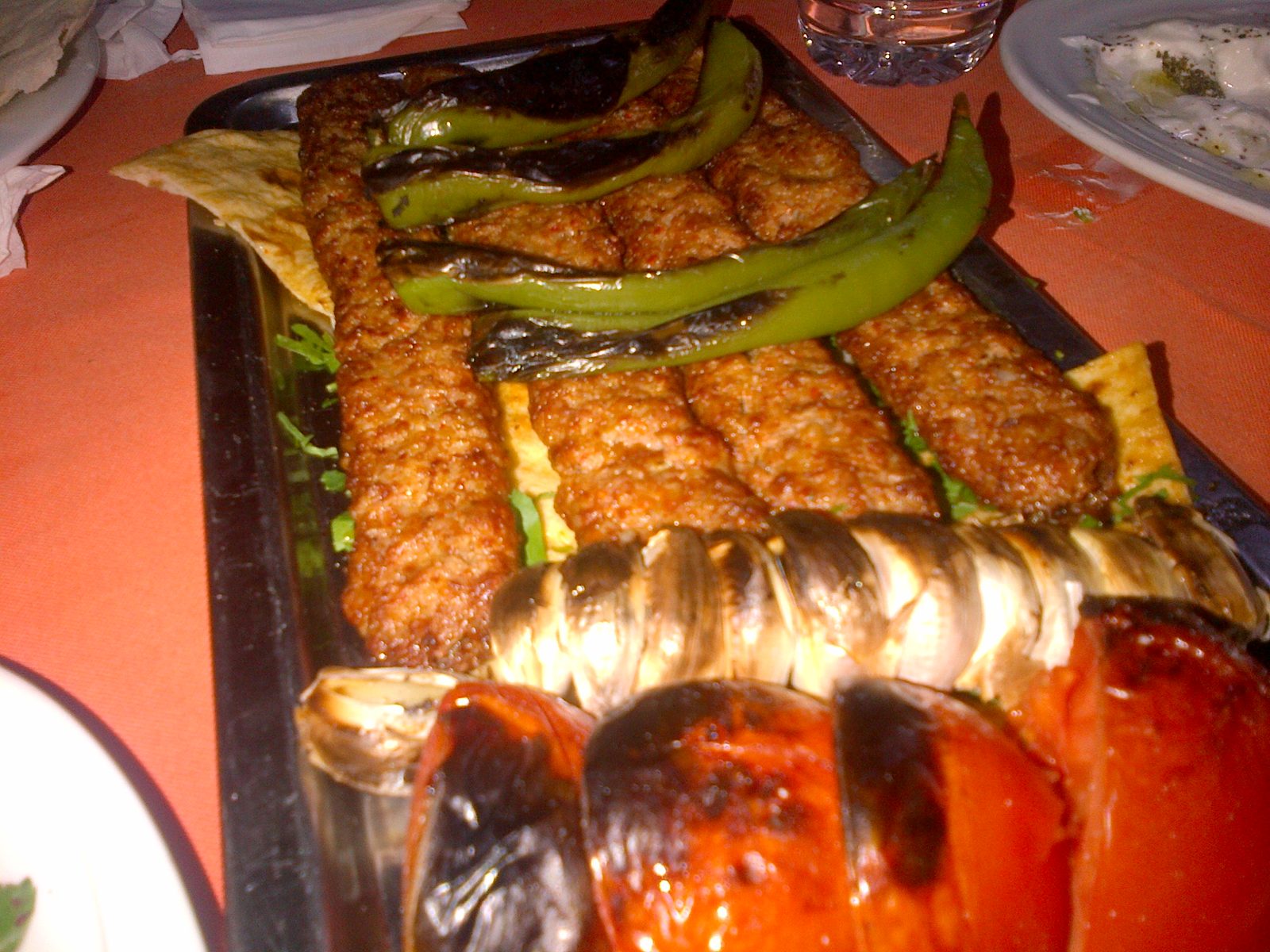
Adana kebab (officially the Adana kebabı — kebab of Adana — protected as a Geographical Indication by Türk Patent Enstitüsü since 2005) is a long band of hand-chopped lamb moulded around a flat metal skewer about 50 centimetres long, seasoned with salt, kuyruk yağı (lamb tail fat) and red Maraş chilli pepper, and grilled over an open charcoal fire for four or five minutes a side. The meat is shaped right onto the skewer by hand and pressed into a flattish elongated cylinder that fills most of the skewer's length. It arrives on a piece of warm lavaş with grilled long green peppers, charred tomato, sumac onion and parsley. You eat it with your hands: tear off a piece of lavaş, lay a piece of the kebab across it, add a few rings of sumac onion and a bite of charred pepper, roll it shut. Drink cold ayran.
The dish is a southern Mediterranean Turkish speciality from the city of Adana on the Çukurova plain, three hundred kilometres south-east of central Anatolia. Cooks moved north with it through the twentieth century, and Adana is now on every kebab menu in Istanbul. The Istanbul question is therefore not whether you can eat Adana but whether the version you've ordered is the real thing.
The zırh question — what makes Adana actually Adana
The single most important technical detail in Adana kebab is what happens to the lamb before it touches the skewer. The real version is hand-chopped with a zırh — a heavy curved Turkish butcher's knife, almost crescent-shaped, with two wooden handles pushed end-to-end across a long block of meat by a cook using both hands. The chopping is rocking, rhythmic, and deliberately uneven: pieces of lamb shoulder are cut down to roughly the size of a small fingernail, with pieces of kuyruk yağı (lamb tail fat) cut coarser and worked through. The salt and chilli are sprinkled on the chopping board midway through and chopped into the meat by the same blade. The whole process takes ten or fifteen minutes per portion.
The texture this produces is unmistakable: irregular, coarse, with bands of fat visible against the leaner meat, the surface of the moulded kebab on the skewer looking visibly chopped rather than smooth. On the cooked plate the meat reads as small distinct pieces rather than a uniform paste. The lamb tail fat melts fast over the charcoal and bastes the leaner meat as it cooks; the cooked surface is mahogany, the interior just barely pink, the fat pockets glistening.
The fake version is minced — run through a grinder, same as a hamburger patty. The cooked result is uniform in colour and texture, pinkish through, with no distinct fat pockets, and a smoother round profile on the skewer. A minced "Adana" is the version sold at most Istanbul tourist menus on Divanyolu and Sultanahmet, and at a depressing number of restaurants further afield. The cleanest tell is the surface: a hand-chopped Adana looks chopped; a minced "Adana" looks like a long meatloaf.
The reason the minced version exists is speed and yield. A zırh chef can hand-chop maybe ten or twelve portions an hour; a meat grinder can mince a hundred. A real Adana kitchen has at least one cook whose entire job is the chopping, alone at the table, hour after hour. A minced "Adana" kitchen has none.
The chilli heat — and why Adana has its own pepper
The other defining detail is the chilli. Real Adana uses red Maraş pepper (pul biber from Kahramanmaraş, a hundred kilometres north-east of Adana) — a coarse-ground dried chilli that gives a low, slow, warm heat at the back of the tongue rather than a sharp front-of-mouth burn. The Maraş chilli is dried over wood smoke before grinding, which adds a smoky note that catches on the charcoal heat at the grill. The chilli is mixed into the meat at the chopping board, not sprinkled on at the end.
The heat is real — a properly hot Adana is a Turkish chilli benchmark — but it's a benchmark that southern Turkish cooks calibrate to local palates, and the heat level you'll get in an Istanbul restaurant is usually notably milder than the heat level a chef in Adana would serve. If you want a properly spiced version, ask for çok acı (very hot) when you order; the kitchen will read this as a request for the southern standard. If you want the mild version, see the next section — there's a separate dish for it.
The Urfa sister — the mild version is its own kebab
Adana has a sister dish that's identical in technique except for the chilli: Urfa kebab (Urfa kebabı), from Şanlıurfa a hundred and fifty kilometres east of Adana, uses no chilli at all. The same lamb, same zırh, same skewer, same charcoal — but seasoned only with salt and pepper, and built around the meat's own flavour rather than the Maraş heat. A well-made Urfa kebab is one of the quietest kebabs in the Turkish catalogue: it lets you taste the lamb tail fat and the wood smoke without the chilli edge.
A serious southern Turkish kebab house will run both on the menu. The order to make if you can't decide: one skewer of each, between two people. The contrast is the whole point. Mention to the waiter that you want the Adana çok acı if you want the heat; the Urfa is the mild contrast either way.
Where to eat real Adana in Istanbul
Four canonical rooms, ranked from working to refined:
- Develi Kebap Sirkeci — Hocapaşa Mahallesi, Hüdavendigâr Caddesi No. 24, Sirkeci. The Sirkeci branch of the long-running Develi dynasty, on a back street behind the historic station. Working-room atmosphere, charcoal grill visible at the back, the zırh chef at the counter most afternoons. The Adana here is the closest version in central Istanbul to what you'd eat in Adana itself.
- Develi Sultanahmet — Gülbahar Hatun Sokak No. 8, Sultanahmet. The historic-peninsula sister, a few minutes from the Hagia Sophia. Same kitchen tradition, more polished room, a slight tourist mark-up.
- Hamdi Restaurant — Tahmis Caddesi No. 17, Eminönü, above the Spice Bazaar. Strictly speaking Hamdi's house style is Şanlıurfa-tradition rather than Adana — see the best-kebab-in-Istanbul blog post for the longer Şanlıurfa story — but the Adana on the menu is properly hand-chopped and worth ordering alongside the Ali Nazik (the house's smoked-aubergine signature). The rooftop view over the Galata Bridge is the second course.
- Develi Etiler — Nispetiye Caddesi No. 71, Etiler. The northern fine-dining flagship of the Develi dynasty (founded 1912 in Gaziantep). Refined room with a Bosphorus outlook, the same zırh tradition delivered in a tasting-menu register. The hand-chopped Adana here is the most polished version in the city — and the çiğ köfte is the legitimate hand-pounded raw-lamb version, rare in Turkey since the raw-meat regulations tightened in 2009. This is the closing course of the Istanbul Kebab Trail walking tour.
What to order with it
The standard plate is two skewers per person (one Adana, one Urfa is the classic order), a stack of warm lavaş, a salad of sumac onion and parsley, a bowl of charred long green peppers and tomato, and cold ayran. Add a small bowl of ezme (the fresh chilli-and-tomato relish from southern Turkey, hand-chopped on the same board as the kebab) and you have the full table. Skip the rice — rice is filler and the lavaş is the bread of record. If you want a starter, the Ali Nazik (smoked-aubergine purée beaten with yoghurt and topped with diced lamb) is the southern Turkish opener; otherwise ask for one of the cold mezes.
How to tell a great Adana from a mediocre one
Three tells, in order. First, the surface: a hand-chopped Adana looks visibly chopped after grilling — uneven, mahogany- crusted, with distinct grains of meat against fat pockets. A smooth, uniform-looking skewer is the minced fake.
Second, the fat: a real Adana renders visible kuyruk yağı as it cooks — small pools of clear fat on the plate beneath the kebab where it sits on the lavaş. Without the lamb tail fat the chilli sits on dry meat and the dish reads as a long meatloaf with chilli; with it the fat carries the chilli and the smoke and the salt across every bite.
Third, the chilli profile: the heat should arrive a beat after the meat, build slowly across the second and third bites, and stay on the back of the tongue without becoming sharp. A front-of-mouth burn that arrives immediately is a cayenne-pepper substitute for Maraş pepper, and the smoke profile that defines a real Adana goes with it.
What's next
Adana sits inside the wider Turkish charcoal-grill spectrum the best-kebab-in-Istanbul blog post covers in long form: Şanlıurfa-style at Hamdi, Gaziantep- style at Develi, cağ kebabı at Şehzade, and the köfte institutions of the Sultanahmet and Beşiktaş Çarşı rooms. The Istanbul Kebab Trail walking tour sequences five of those rooms in a single-afternoon survey ending at Develi Etiler for the hand-chopped Adana finale. The companion explainers so far — What is köfte? and What is cağ kebabı? — cover the other two charcoal-grill institutions of the city.
Every Develi room is in the app.
Develi Etiler, Develi Sultanahmet, Develi Kebap Sirkeci, Hamdi, and 230+ other hand-picked venues across the city — mapped, addressed and walked offline in the free Taste Istanbul app. No tracking pixels, no third-party analytics. Free, no sign-in.
Download Taste Istanbul on the App Store